WOWPASS vs Cash Exchange Hidden Travel Cost Report 2026
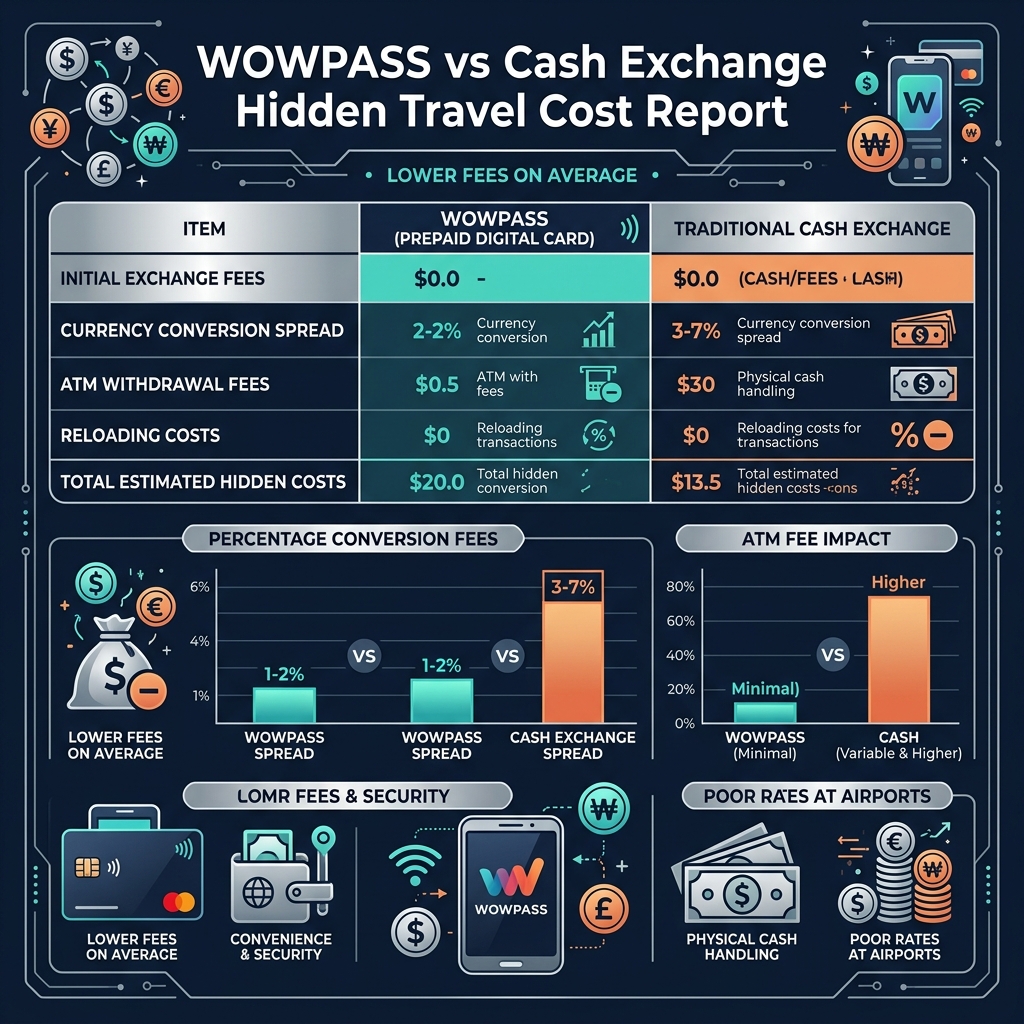
Formulating an accurate Travel Cost plan for an independent tour through South Korea requires calculating the secondary transaction overheads that accumulate during daily checkouts. Many international visitors assume that carrying large amounts of physical cash Won offers the highest flexibility. However, empirical financial data logs reveal that traditional cash conversion methods carry hidden fee structures, physical management risks, and merchant acceptance limitations that lower your net purchasing power.
Comparing the real-world operational parameters of modern travel cards against traditional cash booths isolates the exact fee variables that impact your daily budget.
Quantitative Local Payment Processing and Fee Matrix
The comparison table below details the real transaction costs and convenience ratings across primary local spending tools:
| Financial Asset Tracking Category | Foreign Exchange Loading Spread | Local Point-of-Sale Transaction Fee | Integrated Subway Transit Utility | Primary Kiosk Network Access | Net Convenience ROI Level |
|---|---|---|---|---|---|
| WOWPASS Prepaid Card | 0.5% - 1.0% (Wholesale spread) | 0% (Flat Zero Local Fees) | Fully Integrated (T-Money Chip) | Over 160 Major Metro Stations | Ultra-High (Maximum ROI) |
| Global Credit Card | 1.0% - 3.0% (Home institution) | Variable Interbank Markup | Completely Absent (Cannot scan) | Restricted to Bank ATMs | Medium-Low |
| Traditional Cash Exchange | 5.0% - 9.0% (Airport Counters) | 0% (Face-Value Settle) | Requires Separate Card Purchase | Restricted to Physical Booths | Low Budget Footprint |
Exposing the Hidden Siphons of Traditional Cash Transactions
Analyzing the actual conversion spreads highlights distinct financial tradeoffs that independent tourists routinely miss.
The Airport Cash Conversion Penalty
Attempting to exchange physical paper bills at arrival terminal windows introduces a massive financial penalty. Cash counters at the arrival hall routinely enforce markup spreads ranging from 5% to 9% above the actual interbank wholesale rate. For a standard holiday budget, this processing leak removes significant capital before you even board your airport transfer vehicle. Transitioning your conversion runs to automated lobby kiosks or private city center booths preserves your funding.
The Dynamic Currency Conversion Trap
Relying entirely on standard international credit cards at retail registers frequently triggers the Dynamic Currency Conversion (DCC) merchant setup. If a register terminal prompts you to process a payment in your home country's currency rather than local South Korean Won, the network applies a custom processing spread. This adds an expensive 4% to 8% markup penalty directly to your statement, making local fintech card options far more cost-effective.
Recommended Booking Partners
Compare the real transaction costs and secure direct AREX rail vouchers and hotel stays online.
☞ Korea Travel Intelligence Hub
☞ Related Guide: Best Myeongdong Hotels Near WOWPASS and Currency Exchange
☞ View Pre-Verified Prepaid WOWPASS & Data Vouchers in Comment Section below
Travel Essentials
Verified GearVINTAR 35.5W International Power Adapter
★ 5.0Essential travel gear recommended for optimal safety and comfort during your journeys.
6 Pack US to Europe Plug Adapter - Type C (White)
★ 4.9Essential travel gear recommended for optimal safety and comfort during your journeys.
BESTEK 220v to 110v Converter with USB C 35w
★ 4.8Essential travel gear recommended for optimal safety and comfort during your journeys.
HANYCONY Type E F Plug Adapter
★ 4.8Essential travel gear recommended for optimal safety and comfort during your journeys.