T-Money Card Cost Breakdown for First-Time Visitors
Public Transport Fare Networks in Seoul
Navigating the extensive public transportation network of Seoul requires a standardized payment instrument to pass the automated station gates. For international visitors, the traditional plastic T-Money card functions as the core baseline infrastructure for commuting. Analyzing the actual cost breakdown of this asset prevents budgeting errors upon your initial arrival.
The Core Infrastructure of the T-Money System
The T-Money card is an integrated circuit chip card used to track passenger movement across subways, city buses, and select taxi units. It operates on a pre-funded data model, requiring users to upload cash value to the chip before passing the physical entry turnstiles.
Automatic Transfer Discount Mechanisms
Utilizing a transit card saves significant travel funds compared to single-use paper tickets. The network software applies an automatic free transfer discount when switching between subways and city buses within a continuous 30-minute window, capping your daily commuting costs.
Physical Procurement Fees and Capital Outlays
Understanding the initial transaction requirements prevents confusion when interacting with automated ticket kiosks or convenience store counters.
Initial Card Template Purchase Fees
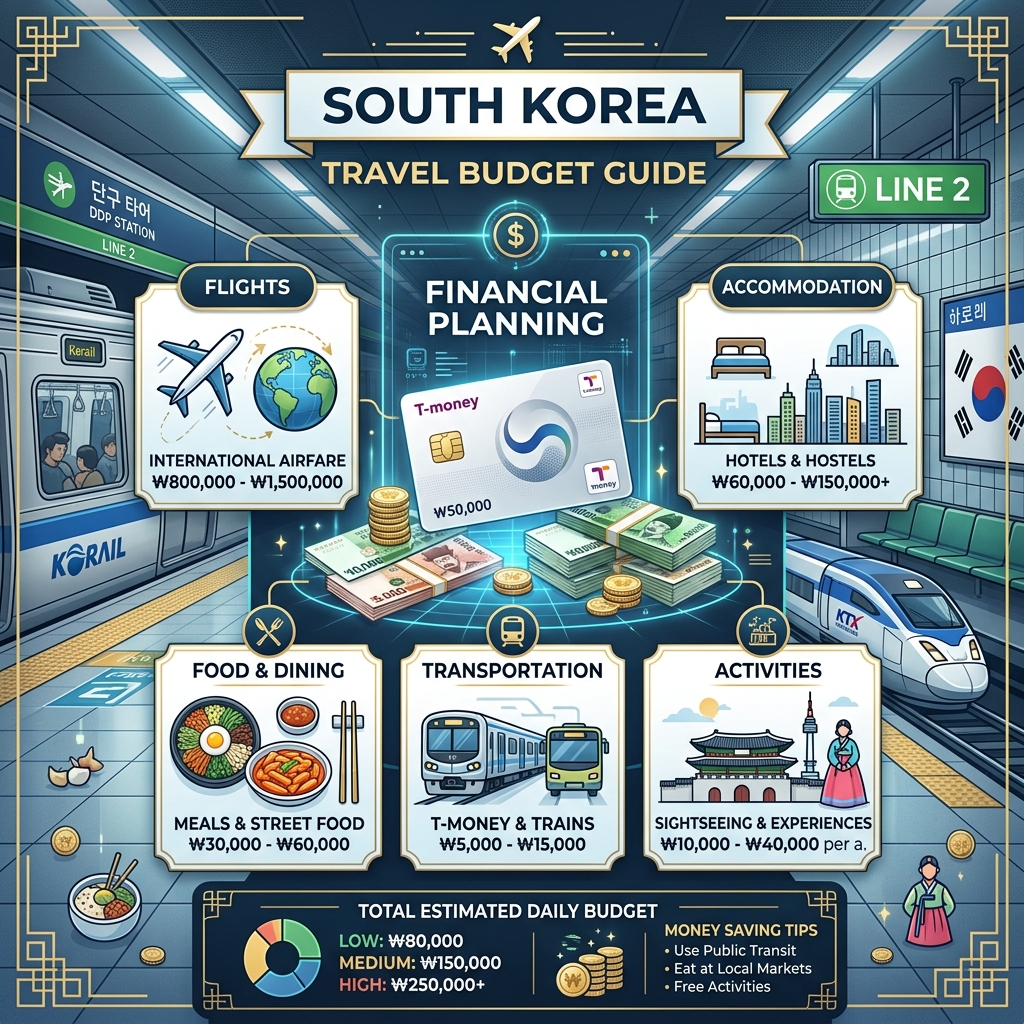
The physical T-Money card is a non-refundable plastic asset template. The official baseline purchase fee for a standard card template is exactly 3,000 KRW to 5,000 KRW (approx. $2.24 to $3.73), depending on the specific character branding or visual design layout selected. This initial transaction strictly covers the physical hardware container and includes exactly zero transit fare balance.
Minimum Mandatory Loading Balances
Once the empty plastic container is procured, you must fund the transit balance separately. Automated station machines accept loading increments starting from 1,000 KRW (approx. $0.75). For a standard 3-day tourist itinerary, an initial loading balance of 15,000 KRW to 20,000 KRW (approx. $11.19 to $14.93) is a practical baseline to clear your initial travel loops.
Verification Rules and Multi-Passenger Constraints
The electronic turnstile network operates on strict data tracking protocols that international visitors must follow to avoid terminal gate locks.
The Individual Tracking Gate Rule
A single physical T-Money card cannot be swiped consecutively for multiple passengers at a standard subway turnstile gate. The rail infrastructure calculates fares based on individual entry and exit distance parameters. Attempting to tap a card twice to let a companion pass will lock the card chip and trigger an immediate terminal system error.
Refund Processing Penalties at Convenience Stores
If you complete your travel itinerary with leftover funds stored inside the chip, you can reclaim that cash before departing the country. Local convenience store counters process immediate cash refunds for balances under 20,000 KRW (approx. $14.93), enforcing a mandatory processing penalty fee of 500 KRW (approx. $0.37) per transaction.
Where to Procure and Refill Transit Cards
Tracking official distribution channels ensures you do not waste time searching for access points after a long flight.
Incheon Airport Terminal Arrival Kiosks
Physical card templates can be purchased immediately after clearing customs. Authorized convenience store chains located throughout the 1st-floor arrivals hall maintain constant inventory stocks of the basic cards, accepting international credit cards for the initial hardware purchase.
City Subway Station Automated Terminals
Once inside the city center, refilling the card balance is handled at the automated multi-lingual ticket machines located inside every subway station lobby. These specific terminal machines operate exclusively on physical cash South Korean Won banknotes, blocking international credit card top-ups.
Financial Analysis: T-Money vs Alternative Single Tickets
Evaluating the total cost delta clarifies the financial efficiency of the card across a standard visitor schedule.
Calculating the Break-Even Window for Tourists
The standard baseline subway fare using a funded T-Money card is exactly 1,550 KRW (approx. $1.16) per individual ride, compared to 1,650 KRW (approx. $1.23) for a single-use paper ticket. Given the 100 KRW (approx. $0.07) discount per ride combined with automatic multi-transit transfer discounts, the upfront card procurement fee completely breaks even by your fourth or fifth city journey.
Forced Contextual Internal Link Hub
After organizing your transport card procurement costs, mapping your broader currency requirements across retail markets and food zones protects your travel capital from high airport conversion spreads. Review our complete financial guide: How Much Cash Do You Really Need in Korea? (2026 Data) to optimize your daily cash distribution matrix efficiently.
Frequently Asked Questions (FAQ)
Q1: Can I use a T-Money card to ride the premium AREX Express Train?
No. The non-stop AREX Express Train functions on an independent QR-code ticketing network and does not accept standard card taps. The T-Money card is utilized explicitly to board the regular AREX All-Stop commuter train.
Q2: Does the physical T-Money card template contain an expiration date?
No. The physical card hardware and the embedded digital chip infrastructure do not expire. Any unused monetary balance stored inside the chip remains valid and fully functional for future visits to South Korea.
Q3: Can children get a discount on T-Money transit fares?
Yes. Children aged 6 to 12 receive a discounted baseline fare profile. To activate these specific discount parameters, you must present the child's official passport to a convenience store cashier to register their birth date onto the card hardware.
Q4: Can I use a T-Money card to pay for items inside convenience stores?
Yes. The loaded cash balance behaves like a localized prepaid wallet asset, accepted for retail transactions at all major convenience store brands, verified parking facilities, and standard city metered taxis.
Q5: Is there a mobile app version of the T-Money card for international tourists?
Mobile transit card apps are functional but require a domestic Korean cellular network registration or specific mobile OS device configurations. For short-term international visitors, utilizing the physical plastic card version remains the most reliable baseline method.
Travel Essentials
Verified GearRFID Blocking Travel Neck Wallet
★ 4.9Essential travel gear recommended for optimal safety and comfort during your journeys.
Skip the ticket queue with a pre-booked mobile QR voucher:
Avoid queue delays at airport ticket offices and secure discount entry. The real-time mobile-only boarding pass registry can be managed below. Access real-time pricing and mobile booking options via the comment section below.
Check live Klook AREX passes and Agoda hotel rates in the Comment Section below (Official Klook Partner Integration)