Seoul Luggage Storage Cost Comparison Matrix 2026
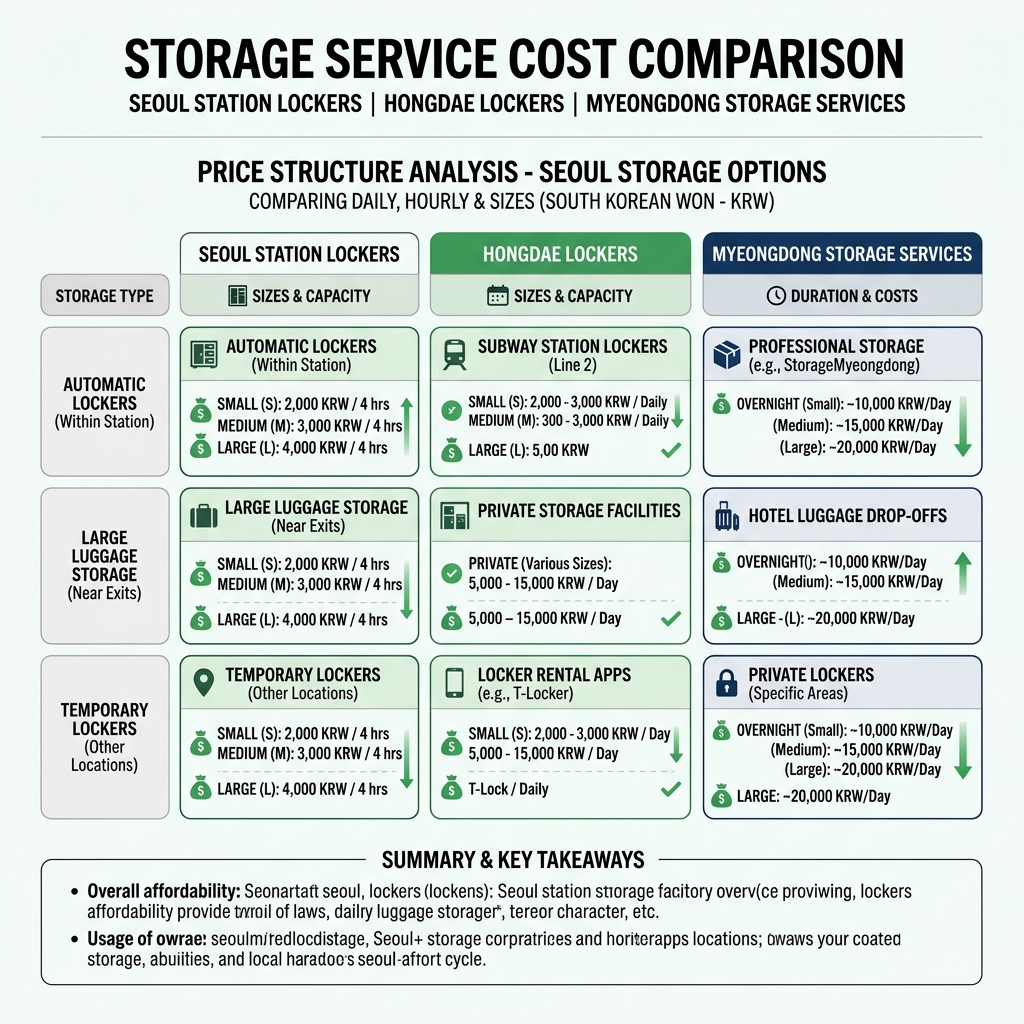
"Formulating an accurate expense log for your time in South Korea requires evaluating the exact pricing matrices governing local luggage storage networks. Storage costs in Seoul are not uniform; they vary significantly based on location, facility type, and total storage time. Analyzing these cost metrics before you arrive allows you to avoid premium tourist price traps and budget your transit capital efficiently."
Overview of Storage Tariff Frameworks
Formulating an accurate expense log for your time in South Korea requires evaluating the exact pricing matrices governing local luggage storage networks. Storage costs in Seoul are not uniform; they vary significantly based on location, facility type, and total storage time. Analyzing these cost metrics before you arrive allows you to avoid premium tourist price traps and budget your transit capital efficiently.
Based on official pricing schedules from municipal and private operators, this data breakdown isolates the most cost-effective methods to secure your gear.
Quantitative Pricing Matrix by Major Hub Stations
The official public subway locker network (T-Locker) enforces a standardized pricing tier across all primary urban transit nodes. The table below details the real baseline costs for the first 4 hours of storage usage.
| Locker Sizing Tier | Base Cost (First 4 Hours) | Overtime Fee (Every 1 Hour Past Base) | Best Suited For |
|---|---|---|---|
| Small (S) | KRW 2,200 (approx. $1.65) | KRW 200 to 500 | Backpacks, Shopping Bags |
| Medium (M) | KRW 3,300 (approx. $2.48) | KRW 400 to 800 | Carry-on Bags, Duffels |
| Large (L) | KRW 4,400 (approx. $3.30) | KRW 500 to 1,000 | 28"+ Checked Suitcases |
Station Volume Variance Variables
While the tariff rates remain identical across all lines, availability indexes drop sharply at high-traffic intersections like Hongik University Station and Myeongdong Station during weekend afternoons. If public station lockers are fully occupied, travelers must shift to private service counters, which utilize different pricing frameworks.
T-Locker Hourly Overtime Accumulation Rules
Understanding how the automated software computes prolonged storage windows prevents unexpected price shocks when tapping out your bags.
The 12-Hour Daily Rate Caps
The initial baseline ticket covers exactly 4 hours of storage. Once your timeline passes the 4-hour mark, the digital terminal applies incremental hourly fees automatically. For extended stays, the system appends a fixed repeat charge every 12 hours, meaning a large checked suitcase left for a full 24-hour window will log a final cumulative fee of approximately KRW 12,000 (approx. $9.00) to KRW 15,000 (approx. $11.20).
Automated Terminal Payment Acceptances
The physical terminal scanners operate using electronic payment processors. International travelers can clear their balances using major international credit cards or local pre-paid transit networks like T-Money and WOWPASS. Cash inputs are restricted on newer models, making a funded digital chip tool essential to clear the gate systems.
Specialized Private Counter Pricing (SAFEX vs Zimcarry)
For large groups handling multiple heavy bags or requiring airport forwarding, private manned service desks provide alternative flat-rate pricing models.
Flat Day-Rate Systems for Oversized Gear
Private manned counters located within major rail hubs generally bypass hourly calculation models in favor of a flat daily rate. Storing a large checked bag at a manned station center typically costs between KRW 7,000 (approx. $5.20) and KRW 10,000 (approx. $7.50) per calendar day. This flat structure becomes highly cost-effective if your sightseeing schedule extends past 8 hours, as it undercuts the climbing hourly accumulation rates of standard subway lockers.
Forced Contextual Internal Link Hub
After reviewing these quantitative storage cost matrices, mapping out the precise physical locations of locker bays inside the station concourses and evaluating delivery networks straight to your accommodation completes your arrival plan. Review our practical field layout guide: Where to Store Luggage in Seoul Before Hotel Check-In to instantly position your bags in safe zones and avoid unnecessary transit delays.
Frequently Asked Questions (FAQ)
Q1: Is it cheaper to use a subway locker or a private storage counter for a 2-hour window?
For short windows under 4 hours, the official subway T-Locker system is significantly cheaper, charging only KRW 4,400 for a large bag compared to the flat daily rates of KRW 7,000+ enforced at private manned counters.
Q2: Do storage delivery services charge extra for heavy checked luggage?
Yes. Same-day delivery services calculate their fees based on total luggage height and weight parameters. Standard checked suitcases under 28 inches cost around KRW 15,000 (approx. $11.20) to KRW 20,000 (approx. $15.00), while oversized gear like golf travel bags or ski cases trigger premium surcharges.
Q3: What is the financial penalty for losing a physical locker key card?
Modern T-Locker banks use completely keyless digital passcode interfaces, meaning there are no physical key cards to lose. If you utilize an old-style key-operated locker at an express bus terminal, a cylinder replacement fine of roughly KRW 15,000 (approx. $11.20) to KRW 20,000 (approx. $15.00) applies.
Q4: Can I pay my storage overtime fee using a foreign mobile wallet app?
Direct mobile wallet systems like Apple Pay or Google Pay can experience regional processing restrictions at automated station terminals depending on the issuing foreign bank. Keeping a physical T-Money card or international credit card on hand remains the most reliable option.
Q5: Are there free luggage storage zones remaining inside Seoul Station?
No. All official public luggage storage options inside Seoul Station and the adjacent airport rail terminals operate under paid configurations managed by approved contractors to maintain high security standards.
Official Express Transit Passes & Mobile QR Tickets:
Secure your high-speed AREX tickets online to clear airport gates without delay. Access official partner ticket booking options in the comment section below.
Book discount airport express tickets in the Comment Section below (Official Partner Integration)


🌐 Incheon Airport Express AREX Ticket Reservations
ReplyDelete☑️ Pre-book Airport Train Tickets (Klook): klook.com/activity/130103-wowpass-card-incheon-airport-pickup/?aid=118863
☑️ Browse Central Seoul Hotel Deals (Agoda): agoda.com/partners/partnerlanding.aspx?cid=1966639