Korea Travel Etiquette Checklist (Public Transport, Restaurants, Hotels, Payments)
Korea Travel Etiquette Checklist (Public Transport, Restaurants, Hotels, Payments)
Establishing Your Cultural Compliance Roadmap
Formulating a practical behavioral checklist before traveling through South Korea ensures you navigate local spaces without causing unintended offense. Cultural expectations in Seoul are highly structured and integrated directly into the daily operations of public infrastructure, retail zones, and dining environments. Analyzing these behavioral metrics alongside your financial calculations protects your travel group from social friction.
Based on official tourism manuals, this matrix outlines the essential etiquette boundaries required to travel with absolute confidence.
1. Public Transportation Decorum Metrics
The municipal transit grid serves millions of commuters daily, operating under strict silent zone codes.
The Turnstile and Platform Protocol
Passengers waiting for subways or city buses must form orderly single lines behind the painted platform gate marks. Pushing or cutting lines breaks transit protocol. Once inside the cabin carriage, keep smartphone volumes silent and avoid any loud verbal communication rows.
Priority Zone Curfew Locking
The designated seats at the ends of the train cars are hard-locked for vulnerable passengers. Even during extreme peak hours where the center aisles are packed tightly, tourists must remain standing and leave these seats completely empty.
2. Restaurant Dining Etiquette Rules
Traditional dining setups follow clear hierarchy and hygiene protocols that dictate your table layout.
Cutlery Sizing and Placement Rules
Never stick your metal chopsticks vertically into a bowl of warm rice, as this configuration resembles funeral incense offerings. Always rest them flat or position them on the side holders. When sharing large hot-pot stews or BBQ platters, utilize the long communal tongs and shears rather than dipping your personal chopsticks directly into the main serving dishes.
The Table Cleansing Framework
Blowing your nose openly at a dining table is viewed as a major cleanliness violation. If you experience spicy broth reactions, step into the corridor or restroom space. At the end of the meal, leave your used napkins folded neatly on the table side rather than dropping them directly into empty food bowls.
3. Payment Protocols and Financial Exchanges
Clearing balances across the cashless network incorporates nonverbal respect codes.
The Two-Hand Delivery Constraint
Whether swiping your pre-paid travel card at a retail counter or presenting your passport asset to a train inspector, always use both hands to execute the exchange. If your left hand is occupied holding bags, rest your left fingertips lightly under your right wrist or forearm to fulfill the modesty protocol.
Tipping Policy Rejection Realities
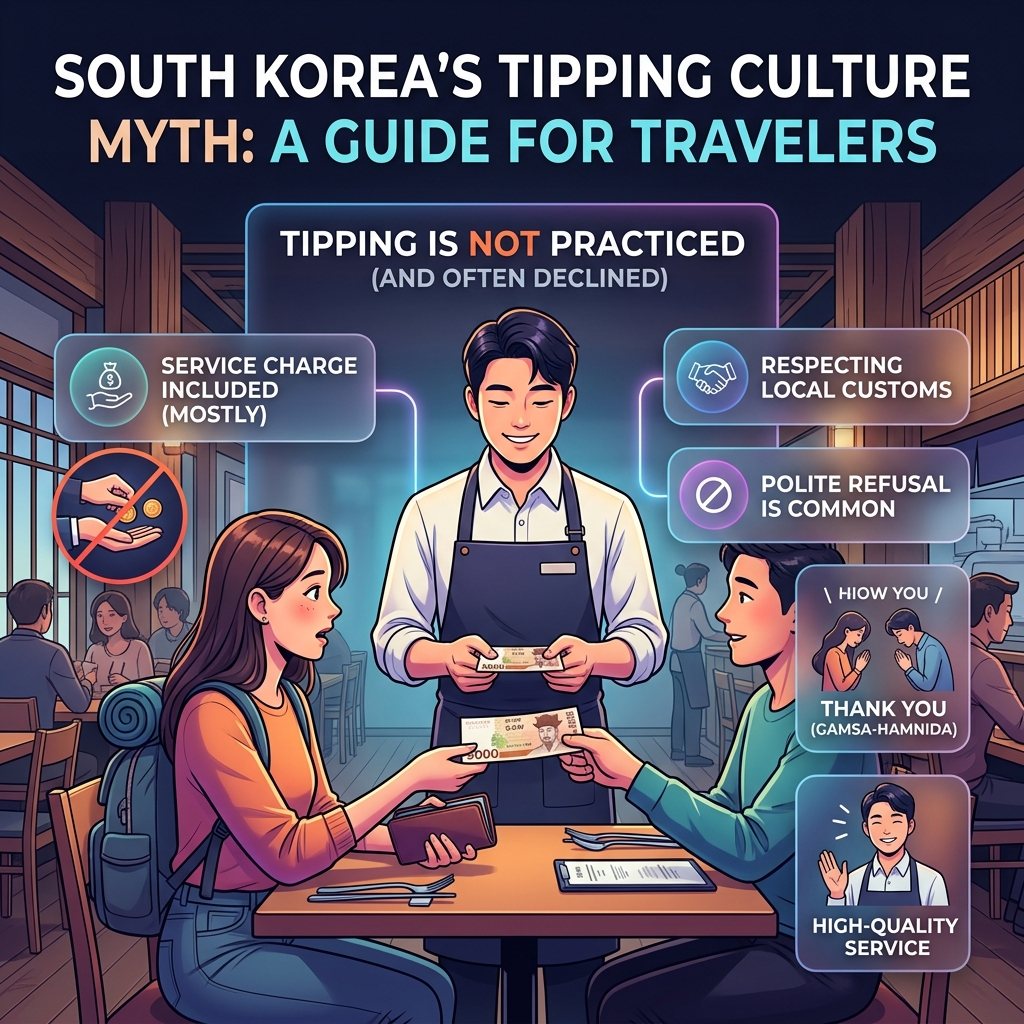
Tipping is completely barred across the domestic service economy. Casual dining establishments, premium cocktail bars, and city metered taxis operate under strict face-value pricing registers. Attempting to leave a cash tip creates confusion, as cashiers are legally required to balance their daily cash registers to the exact Won.
4. Accommodation and Hotel Property Codes
Managing your lodging stay requires balancing privacy expectations against property layout boundaries.
The Shoe-Off Entrance Boundary
Upon stepping past the threshold of traditional accommodations or boutique guesthouses, verify the flooring layout immediately. Shoes must be unlaced and stored inside the lower entrance foyer box before your socks touch the main interior floor tiles.
Contextual Internal Link Hub
Understanding these localized property rules and payment behaviors prevents awkward encounters during your holiday checkout loops. Review our complete social risk manual: 10 Things You Should Never Do in Korea as a Tourist to instantly map your daily behavioral choices and ensure complete cultural compliance across every neighborhood intersection you cross.
5. Etiquette Verification Matrix by Category
The table below summarizes the core behavioral guidelines and potential penalty impacts across the primary tourist interaction zones:
| Category Sector | Mandatory Action Required | Taboo Behavior to Avoid | Real Cost / Social Impact Risk |
|---|---|---|---|
| Public Transport | Stand near regular lanes | Sitting in Priority Seats | Direct Disapproval / Stares |
| Dining Blocks | Lay chopsticks flat | Sticking chopsticks in rice | Association with Bad Luck |
| Retail Checkout | Present card with both hands | One-handed sliding of cash | Viewed as Dismissive / Rude |
| Waste Management | Separate food from plastic | Mixing recyclable materials | Municipal Administrative Fines |
Looking for more guides?
Return to Intel HubFrequently Asked Questions (FAQ)
Q1: Are there official fines enforced for mixing garbage categories?
Yes. National waste management regulations dictate that improper disposal or failing to utilize the official color-coded municipal garbage bags can result in administrative fines ranging from KRW 100,000 to KRW 300,000 (approx. $74.50 to $223.50) processed by district compliance officers.
Q2: What should I do when an elderly person boards a crowded bus?
If you are sitting in a standard, non-priority seat and an elderly commuter stands near your row, the polite and expected response is to catch their eye, nod slightly, and stand up to offer them your seat asset immediately.
Q3: Is it considered rude to hold the elevator door open for strangers?
No. Holding the elevator door open by pressing the open button is viewed as highly helpful and polite. However, once inside, local efficiency codes prefer that you press the close door button instantly to speed up the vertical transit loop.
Q4: Can I use digital payment card networks to clear street market balances?
The vast majority of modern brick-and-mortar market vendors accept standard electronic credit networks or WOWPASS cards perfectly. However, independent outdoor mobile carts handling small food items under KRW 5,000 (approx. $3.70) strictly require physical cash Won banknotes.
Q5: Do hotel front desks supply disposable indoor slippers?
Yes. Most mid-range and premium hotels provide sterilized or disposable cloth indoor slippers inside the room wardrobe blocks. Guests are expected to use these slippers exclusively on the carpeted interior zones to maintain cleanliness.
[ 하단 리소스 박스 / 라이브 예약 보관소 ]
대중교통 마찰과 불필요한 환전 수수료 누수 없이 스마트폰으로 즉시 예약 가능한 공인 모바일 전용 고속 교통권 및 거점 숙소 대장은 아래 장부에서 직접 조회가 가능합니다.
"Systematic compliance with localized etiquette matrices eliminates unnecessary friction inside retail and public transport loops."


Comments
Post a Comment