Gyeongbokgung Crowd Level by Hour: Visitor Timing Matrix
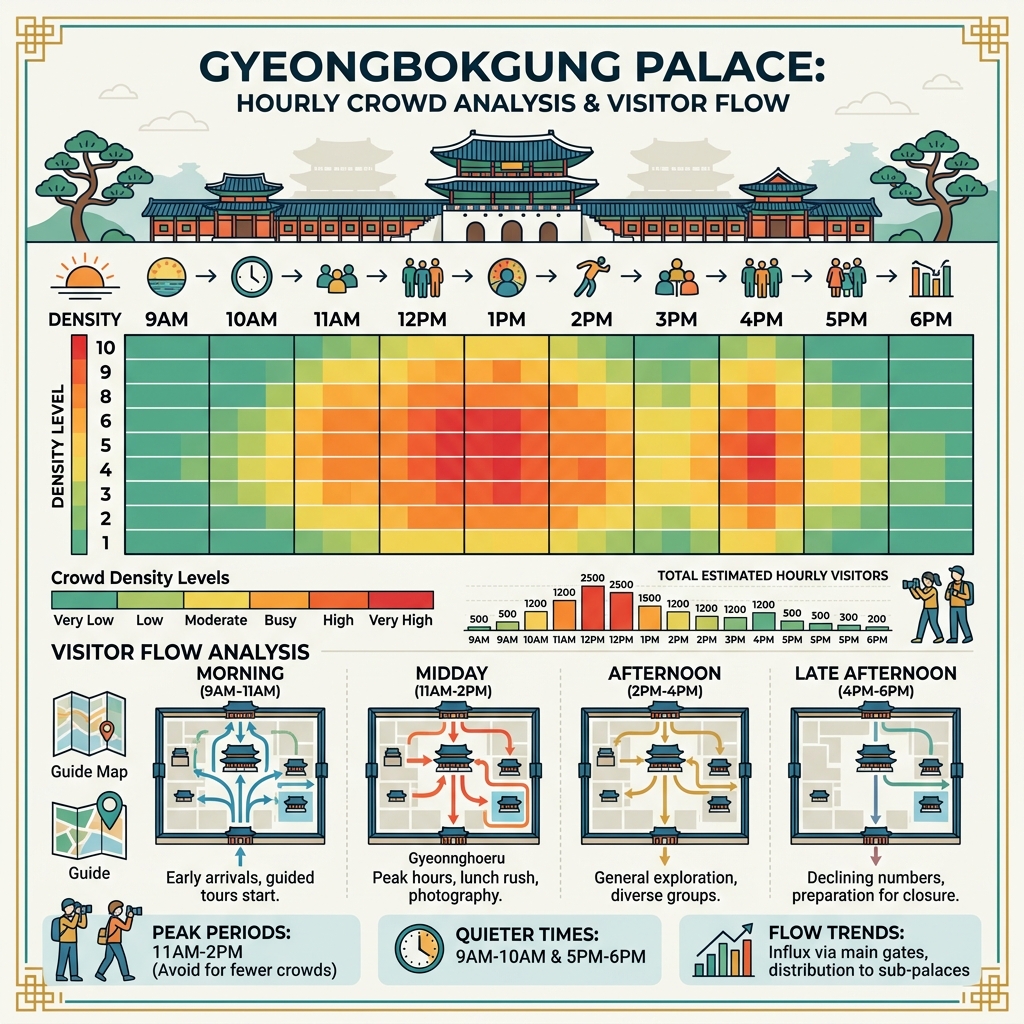
"Formulating an accurate timeline for your cultural sightseeing itinerary inside Seoul requires analyzing the official pedestrian density data logs. Gyeongbokgung Palace behaves in a highly predictable manner regarding how crowds accumulate and disperse throughout the operating day. Mapping these specific hourly patterns allows international visitors to optimize their photography windows and avoid long lines at the ticket distribution windows."
Statistical Analysis of Palace Pedestrian Flows
Formulating an accurate timeline for your cultural sightseeing itinerary inside Seoul requires analyzing the official pedestrian density data logs. Gyeongbokgung Palace behaves in a highly predictable manner regarding how crowds accumulate and disperse throughout the operating day. Mapping these specific hourly patterns allows international visitors to optimize their photography windows and avoid long lines at the ticket distribution windows.
Based on public admission data records, organizing your arrival to match low-density windows protects your travel schedule from unnecessary delays.
Detailed Hourly Crowd Density Metrics
Morning Off-Peak Windows (09:00 AM – 11:00 AM)
The initial opening block represents the lowest density window of the day. Between 09:00 AM and 10:00 AM, ticket counter volume is near zero, allowing for immediate entry processing. The inner courtyards are largely clear of large tour groups, making this two-hour block the most efficient window for clear, wide-angle architectural framing, requiring only 60 minutes of exploration.
The Peak Midday Congestion Wave (11:00 AM – 15:00 PM)
According to visitor volume tracking metrics, density rises sharply after 11:00 AM. This block handles the confluence of independent travelers, international tour bus drop-offs, and local office workers crossing through the open public plazas. The main throne hall steps become heavily crowded, creating significant obstacles for clear travel photography.
Late Afternoon Clearance Windows (15:00 PM – Closing)
Foot traffic begins to recede steadily after 15:00 PM as tour groups depart toward regional dining hubs. The final two hours before the main entry gates lock provide a secondary quiet window. The low-angled afternoon sunlight during this phase offers unique warm lighting conditions across the traditional clay roof tiling.
Royal Guard Changing Ceremony Impact Schedules
Ceremony Timelines and Courtyard Accumulations
The official Sumunjang (Royal Guard) Changing Ceremony is executed daily at exactly 10:00 AM and 14:00 PM outside the Heungnyemun gate plaza. These 20-minute ceremonial events attract massive static crowds. The foot traffic completely freezes around the main gate architecture, making it highly difficult to cross between the outer squares and the inner palace ticket turnstiles.
Operational Ticket and Hanbok Dress Entry Rules
Understanding the exact admission rules helps you navigate the entrance layout quickly without get stuck in the wrong pedestrian lane rows.
Free Admission Infrastructure for Traditional Dress
The cultural heritage administration maintains a strict policy rule that grants automatic free admission to any visitor wearing proper traditional Hanbok attire. If you are utilizing this specific option, you do not need to wait in the standard paper ticket lines; you can walk directly past the main gate inspectors to clear the entry perimeter.
Forced Contextual Internal Link Hub
After organizing your hourly time parameters from the visitor flow chart, discovering how to coordinate your morning arrival steps to secure a completely empty courtyard view completes your sightseeing setup. Review our detailed field mapping log: Best Time to Visit Gyeongbokgung Palace Without Crowds to instantly position your schedule and avoid large tour group deployments entirely.
Frequently Asked Questions (FAQ)
Q1: What time do the main entry gates lock for the day?
While the palace remains open until 17:00 PM or 18:30 PM depending on seasonal daylight variations, the official ticketing windows and final entry turnstiles lock completely exactly one hour before the final closing time.
Q2: Do the crowd levels change significantly during weekend periods?
Yes. Weekend tracking logs show a 40% to 60% increase in total daily foot traffic compared to standard weekdays, due to a rising number of domestic families, student excursions, and local weekend visitors.
Q3: Is the guard changing ceremony executed during heavy rain?
No. Based on official operational codes, the royal guard changing ceremony can be modified, shortened, or completely canceled during inclement weather conditions, such as heavy downpours or severe winter snow warnings.
Q4: Can I buy my Gyeongbokgung admission tickets online in advance?
Online ticket systems are functional but are frequently restricted to domestic payment verification frameworks or fixed daily quotas for international tourists. Purchasing your standard admission ticket, which costs exactly 3,000 KRW (approx. $2.20), via the physical automated kiosks upon arrival at 09:00 AM remains the most practical method.
Q5: Does the entry ticket include access to the National Palace Museum?
Yes. The National Palace Museum of Korea is located inside the western perimeter of the Gyeongbokgung complex and features completely free admission for all international visitors, operating on a separate independent entry schedule.
Official Airport Train Passes & eSIM Data Profiles:
Secure your high-speed AREX train tickets and data-enabled eSIM profiles online to bypass ticketing queues at Incheon Airport. Access official partner links in the comment section below.
Check live discount AREX ticket options and eSIM data links in the Comment Section below (Official Partner Integration)


🌐 Gyeongbokgung Palace Visitor Hub & Train Tickets
ReplyDelete☑️ Pre-book AREX High-Speed Airport Rail Pass: klook.com/activity/130103-wowpass-card-incheon-airport-pickup/?aid=118863
☑️ Browse Seoul Station & Downtown Hotel Deals: agoda.com/partners/partnerlanding.aspx?cid=1966639