Korea Travel Phone Setup: eSIM vs Roaming Cost Analysis (2026)
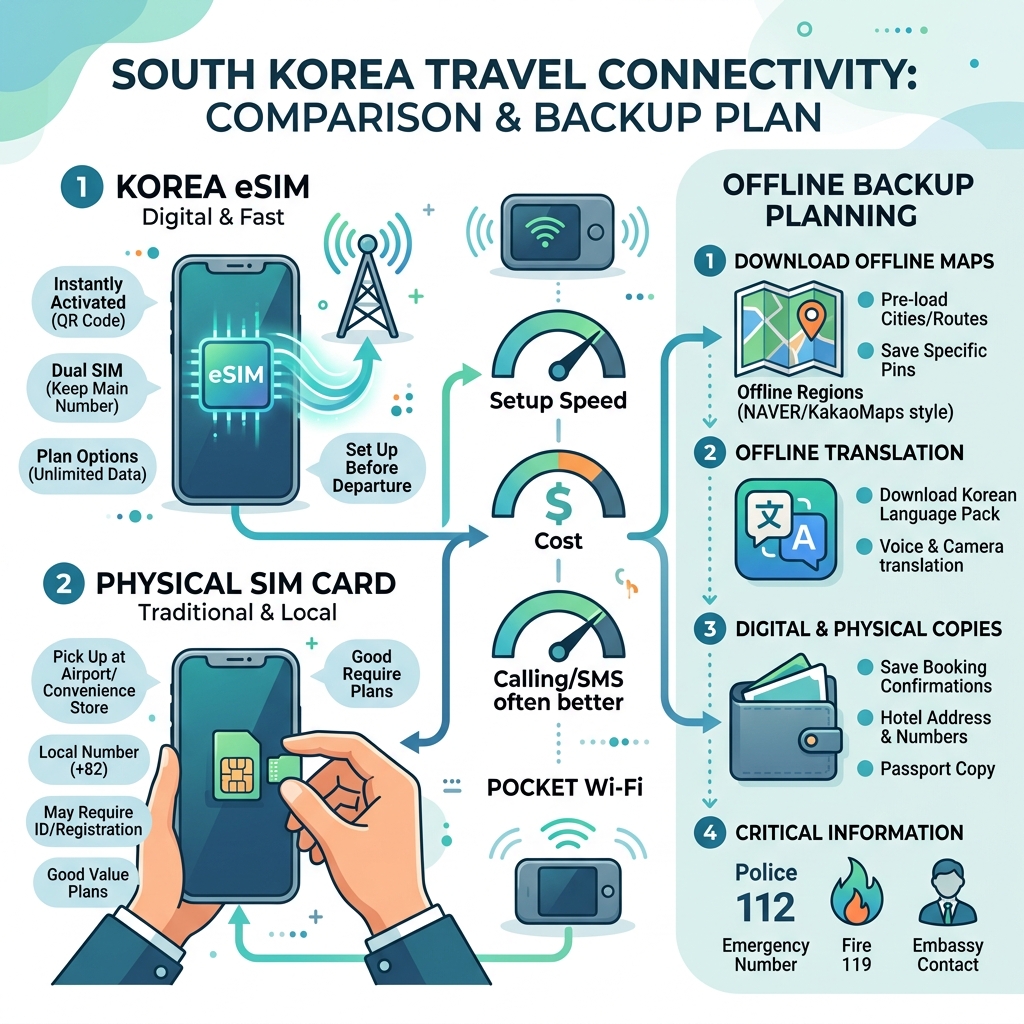
Korea Travel Phone Setup: eSIM, Roaming and Offline Cost Considerations
1. Financial and Operational Risk of Mobile Connectivity Failure
Mobile data in South Korea is not an optional travel luxury; it is a core navigation requirement. Hailing Kakao T taxis, finding street entrances on Naver Map, translating medical or food instructions via Papago, and authenticating hotel reservations require constant internet connectivity. Relying entirely on domestic carrier roaming or public Wi-Fi creates significant financial and operational risks. Evaluating your phone setup requires comparing financial costs against setup friction, device compatibility, and emergency backup reliability. For actionable pre-departure checklist steps, review our companion guide: Before You Fly to Korea: 7 Phone Settings to Check for a Smoother Arrival.
2. Comparative Matrix: eSIM vs. Physical SIM vs. Roaming vs. Offline Only
| Connectivity Strategy | Typical Cost Structure | Setup & Airport Friction | Primary Operational Risk |
|---|---|---|---|
| Prepaid Digital eSIM | Fixed upfront plan ($12 – $25 / week) | Instant QR code download; zero airport counter lines | Requires carrier-unlocked phone and eSIM hardware support. |
| Physical Tourist SIM | Fixed upfront plan ($20 – $35 / week) | Airport desk queues; physical card swapping | Risk of misplacing small domestic SIM card during travel. |
| Domestic Carrier Roaming | Daily pass billing ($10 / day = $70 / week) | Automatic activation; zero technical setup | Highest overall cost; daily high-speed throttling after 500MB. |
| Offline Only + Public Wi-Fi | $0 direct expenditure | Requires manual map and dictionary pre-downloads | Cannot hail Kakao T taxis or access live train delays on the street. |
3. Total Cost Formula & Usage Trade-Offs
A comprehensive connectivity cost calculation follows this equation:
Total Connectivity Outlay = Base Data Plan Price + Excess Surcharge Passes + Device Physical Swapping Friction + Lost Transit Time
- The Lowest-Cost Option vs. The Best Value: Relying exclusively on free subway Wi-Fi and offline maps costs $0, but if you cannot communicate with your Seoul host or hail a ride when lost in an alley at midnight, the time and stress cost far outweighs a $15 eSIM package.
- The Carrier Roaming Trap: Major North American carriers charge $10/day for international day passes. For a 12-day vacation, this generates $120 in roaming fees. A prepaid digital eSIM covering the same period costs approximately $20 to $25, yielding nearly $100 in direct cash savings.
4. Offline Backup Economics: What Actually Saves Money?
Preparing offline data backups (saving offline Naver Map bookmarks, caching Papago Korean language dictionaries, and storing PDF booking confirmations) does not replace active data, but it prevents emergency expenses. If cellular reception fluctuates inside basement shopping arcades or subway concourses, offline backups eliminate panic and keep you moving without costly domestic roaming fallbacks.
5. Decision Intelligence Summary
The most budget-friendly connectivity option is not necessarily the simplest for every traveler. For travelers with unlocked devices, digital eSIM delivers the optimal balance of immediate airport connectivity, zero counter friction, and low overall cost. Pair an active eSIM with offline app preparation to guarantee total reliability across South Korea.
{TRAVEL_ESSENTIALS_BOX}{AGODA_CTA}{KLOOK_CTA}{COMMENT_VAULT}Recommended Intelligence Hubs
- Before You Fly to Korea: 7 Phone Settings to Check
- Korea Travel Charging Essentials: Setup & Cost Comparison Guide
- What to Pack for a Long Korea Travel Day: Power, Charging and Airport Essentials
- Seoul Station Transit & Payment Analysis
- Incheon Airport Express & Bus Cost Database
- Korea Public Transport & Transit Fee Comparison
Travel Essentials
Verified GearNeutrogena Ultra Sheer Dry-Touch SPF 55
★ 5.0Essential verified travel gear recommended for optimal safety, convenience, and comfort.
EltaMD UV Clear Broad Spectrum SPF 46
★ 4.9Essential verified travel gear recommended for optimal safety, convenience, and comfort.
Neutrogena Beach Defense SPF 50 Stick
★ 4.8Essential verified travel gear recommended for optimal safety, convenience, and comfort.