Incheon Airport Express (AREX) ROI Analysis 2026
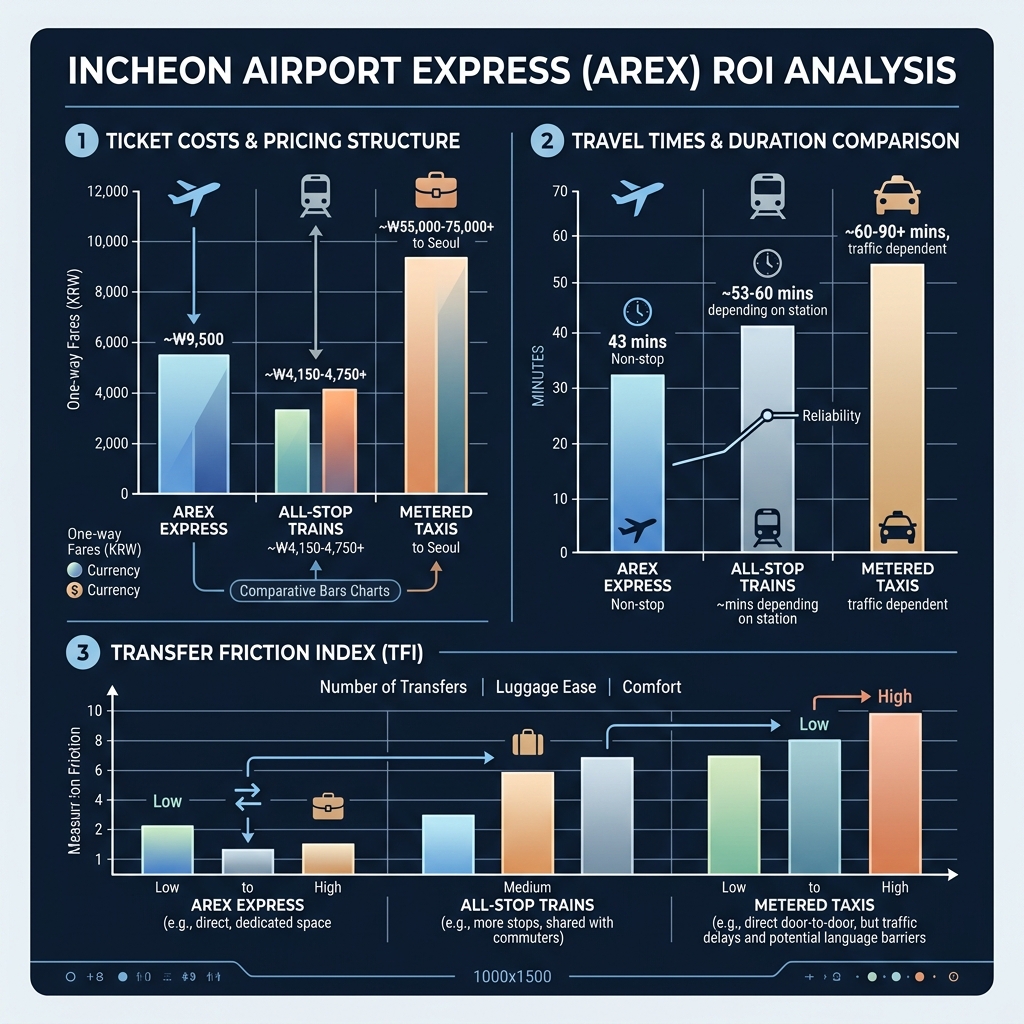
"Formulating an optimal logistical path from Incheon International Airport into central Seoul requires analyzing the empirical financial and time metrics governing the regional rail network. Independent travelers frequently look only at the face-value ticket price when selecting a transit asset. However, a true Return on Investment (ROI) calculation must factor in net travel speed, predictability variables, and the physical cost of transfer friction. Evaluating these precise operational sheets prevents unexpected budget drainage and optimizes your day-one itinerary timelines."
Formulating an optimal logistical path from Incheon International Airport into central Seoul requires analyzing the empirical financial and time metrics governing the regional rail network. Independent travelers frequently look only at the face-value ticket price when selecting a transit asset. However, a true Return on Investment (ROI) calculation must factor in net travel speed, predictability variables, and the physical cost of transfer friction.
Evaluating these precise operational sheets prevents unexpected budget drainage and optimizes your day-one itinerary timelines.
Transfer Asset Cost and Speed Comparison Matrix
The quantitative data table below isolates the core performance parameters enforced by the regional transport corporations and municipal transit bureaus for 2026:
| Transit Asset Classification | One-Way Adult Ticket Cost | Net Travel Duration (To Seoul Stn) | Schedule Predictability Rate | Physical Luggage Handling Strain | Target Group Size Efficiency |
|---|---|---|---|---|---|
| AREX Non-Stop Express | KRW 13,000 (Walk-Up) | 43 Minutes (Fixed) | 100% (Isolated Rails) | Medium (Station Elevators) | 1 - 2 Passengers (High ROI) |
| AREX All-Stop Train | KRW 4,150 - 4,750 | 53 - 60 Minutes | 98% (Suburban Crowds) | High (Commuter Standing) | Solo Budget Travelers |
| Standard Metered Taxi | KRW 55,000 - 68,000 | 50 - 75 Minutes | 75% (Highway Traffic) | Low (Trunk Delivery) | 3 - 4 Passengers (Optimal) |
| Premium Limousine Bus | KRW 17,000 | 60 - 80 Minutes | 85% (Bus Lane Priority) | Low (Staff Stowed Cargo) | Mid-Range Solo / Couples |
Computing the Real-Time ROI: Solo Passengers vs Group Dynamics
The financial math governing your transportation choice shifts dramatically based on the headcount of your travel party.
The Solo and Duo Passenger Math
For solo independent tourists or traveling couples, the AREX Non-Stop Express delivers an unbeatable ROI. Purchasing two digital vouchers online drops your transport capital outlay significantly compared to a private sedan. Furthermore, because the rail asset operates on a dedicated subterranean track completely isolated from surface highway bottlenecks, it guarantees a fixed 43-minute timeline, completely protecting your schedule from weekday rush-hour gridlocks.
The Group Tipping Point Formula
As your individual passenger count crosses the threshold to 3 or 4 individuals, the private metered taxi options alter the financial layout. Splitting a standard taxi meter (~KRW 60,000) among four passengers matches the cumulative cost of four separate express train tickets. In this scenario, the taxi's direct door-to-door lobby delivery yields a superior convenience ROI by completely removing the secondary metro transfer effort inside central hubs.
Forced Contextual Internal Link Hub: Once your travel party processes the quantitative ROI of these competing rail and surface networks, identifying the specific operational mistakes, vehicle classifications, and hidden surcharge layers that govern street taxi hailing completes your arrival blueprint. Review our comprehensive field guide: Incheon Airport Taxi Cost Mistakes to Avoid (2026 Guide) to instantly position your ground transport steps and protect your travel funds from unauthorized driver markups.
Frequently Asked Questions (FAQ)
Q1: Does the Klook digital AREX voucher require a physical ticket exchange at the counter?
No. Digital vouchers secured online generate an instant high-resolution mobile QR code. Travelers scan this digital barcode asset directly at the orange automated express turnstiles, completely bypassing the physical ticket machine lines.
Q2: What is the exact operation interval for the Non-Stop Express trains?
The AREX Express trains maintain a highly consistent dispatch interval of exactly 20 to 40 minutes throughout the daytime operating window, running continuously from early morning until the final departure at 22:50 PM.
Q3: Are there separate child discounts enforced on the Express rail line?
Yes. Children aged 6 to 12 receive a discounted baseline ticket fare of exactly KRW 7,500 at the official service windows, while toddlers under the age of 6 ride free of charge provided they do not occupy an independent seat unit.
Q4: Can I execute a subway transfer discount when exiting the AREX Express gates?
No. Because the Non-Stop Express operates under an independent corporate tariff grid, it does not integrate into the municipal free-transfer alliance. Exiting the express turnstiles and entering local subway Line 1 or Line 4 resets the base boarding fare row.
Q5: Is the All-Stop commuter train equipped with dedicated luggage racks?
The All-Stop commuter rail configuration mirrors a standard metro layout with long bench seats. While it houses small luggage bars near select doors, it faces extreme passenger density during local commuter rush hours, increasing physical luggage management strain.
.
• - AREX QR (Klook Official Partner Link)
• (Agoda Official Partner Link)


Comments
Post a Comment