Airport Bus vs AREX vs Taxi: Cost and Time Comparison (2026)
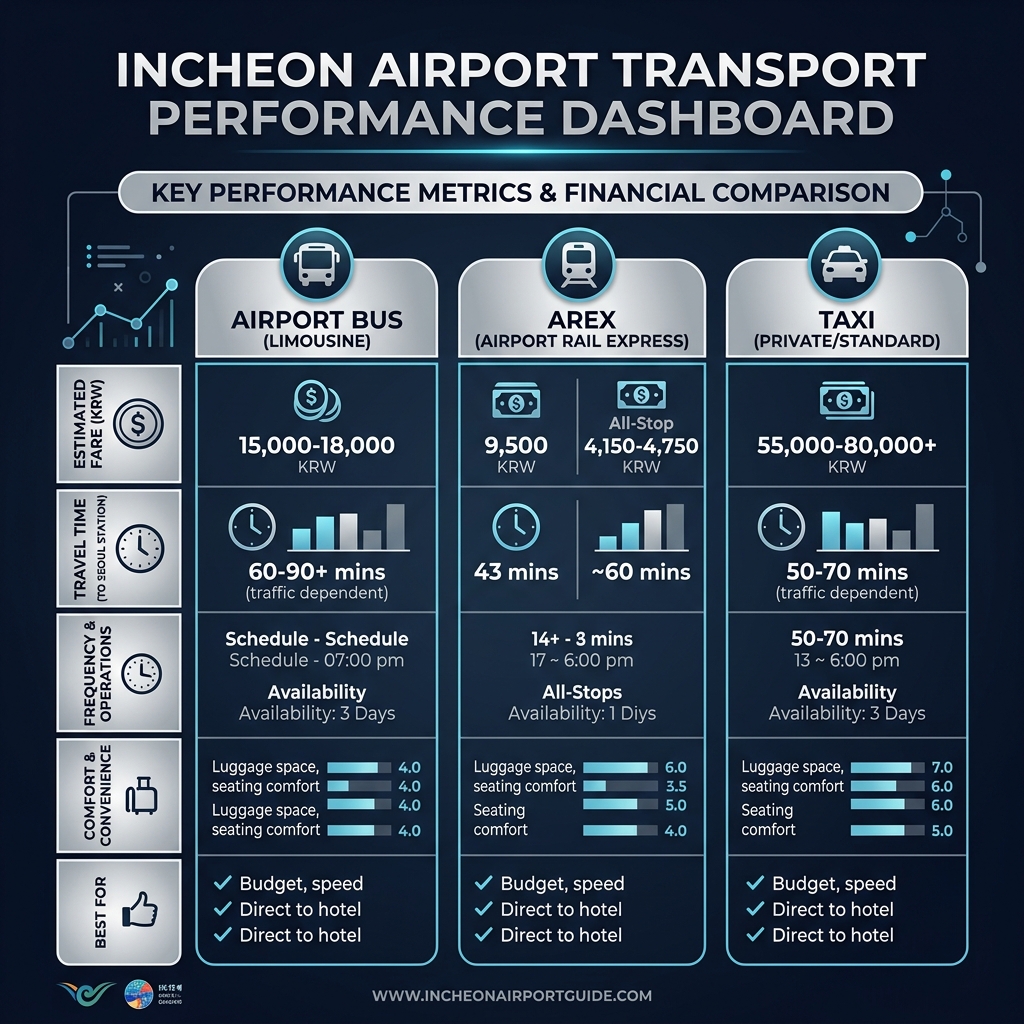
"Formulating an accurate capital deployment plan for an inbound trip through South Korea requires analyzing more than basic nightly hotel rates. Independent travelers frequently fall into the trap of selecting a ground transportation instrument based entirely on raw face-value ticket prices."
Formulating an accurate capital deployment plan for an inbound trip through South Korea requires analyzing more than basic nightly hotel rates. Independent travelers frequently fall into the trap of selecting a ground transportation instrument based entirely on raw face-value ticket prices, completely overlooking the secondary costs of transport time deficits, intermediate transfer friction, and luggage handling strain.
This analytical comparison report decouples the precise operational expenditures, journey speeds, and convenience return-on-investment scores verified across the three dominant Incheon Airport transport systems for 2026.
Inbound Ground Transportation Cost and Efficiency Matrix
The quantitative data table below isolates the core financial parameters and transit variables recorded by regional transport corporations and municipal transit bureaus:
| Transit Classification | One-Way Adult Cost | Avg. Duration (Off-Peak) | Transfer Friction | Luggage Strain | Best Group Size | Surcharge Risk |
|---|---|---|---|---|---|---|
| AREX Non-Stop Express | KRW 13,000 | 43 min | High (Deep Underground) | Medium | Solo / Couple | Fixed Schedule |
| Deluxe Airport Limousine | KRW 17,000 | 65 – 75 min | Zero (Surface Curb) | Ultra-Low | 1 – 3 Passengers | Highway Traffic |
| Standard Metered Taxi | KRW 55,000 – 68,000 | 50 – 60 min | Zero (Hotel Lobby) | Low | 3 – 4 (Max ROI) | +20–40% Night Fee |
Computing the Real-Time ROI: Financial Costs vs Physical Friction
The financial math governing your transportation choice shifts dramatically based on the headcount of your travel party.
The Solo and Duo Passenger Friction Tradeoff
For solo independent tourists or traveling couples, the AREX Express rail delivers the absolute fastest travel speed, cutting straight to central Seoul Station over isolated tracks. However, its major limitation is vertical station friction. The rail platforms are situated deep underground, forcing travelers to drag heavy bags across multiple escalators and long station corridors. The Deluxe Airport Bus vs AREX debate highlights that the bus commands a slight premium but routes directly along surface avenues, dropping passengers off at hotel doorsteps with zero mid-journey transfers.
The Group Tipping Point Formula
As your individual passenger count crosses the threshold to 3 or 4 individuals, the private metered taxi Korea options completely alter the financial layout. Splitting a standard taxi meter (~KRW 60,000) among four separate passengers matches the cumulative cost of separate airport bus tickets. In this scenario, the taxi's direct door-to-door lobby delivery yields a superior convenience ROI by completely removing the secondary walking effort from the curb to your check-in desk, making it the most mathematically efficient selection.
Internal Link Hub
Once your travel party processes the quantitative realities of these competing airport transfer channels, identifying the specific premium accommodations that host dedicated coach drop-off zones right at their lobby pavement completes your arrival blueprint.
Review our verified group travel field report: Seoul Station Hotels for Group Travel: Airport Bus, KTX & Family Tips (2026) to select your central lodging asset optimized for multi-person group configurations.
Frequently Asked Questions (FAQ)
Q1: Does the highway expressway toll get added on top of the taxi meter?
Yes. Standard metered taxis record running distance fees exclusively. Any automated highway bridge toll fees encountered during the run, including the KRW 6,600 airport expressway toll, are appended directly to the final meter balance at the destination curb.
Q2: Can I board the AREX Non-Stop Express using a standard T-Money card?
No. The premium non-stop AREX Express train operates on a separate dedicated ticketing system. Standard T-Money cards are only accepted on the All-Stop local commuter train, which makes multiple suburban station stops along the full route before reaching central Seoul Station.
Q3: Do airport limousine buses apply different fare tiers for children?
Yes. Children aged 6 to 12 qualify for discounted child fare tiers, which are approximately 30% lower than the standard adult fare. Infants below 6 years of age ride completely free provided they do not occupy a standalone independent seat unit.
Q4: What happens if surface bus traffic delays extend my journey time significantly?
When booking early morning flights with tight check-in deadlines, always allocate a minimum safety buffer of 30 to 45 additional minutes beyond the published average travel duration. On weekday mornings between 08:00 AM and 09:30 AM, major bridge crossings and urban expressways can experience significant congestion waves.
Q5: Are all three transit options available 24 hours a day from Incheon Airport?
No. AREX and airport limousine buses operate within fixed daily schedules, typically running from early morning until approximately 23:00 PM. After midnight, metered taxis remain the primary ground transport option for late-night arrivals clearing international immigration after the standard transit cutoff windows.
• Access Real-Time Market Room Tariffs and Exclusive Member Discounts for Top-Rated Seoul Station Accommodations (Agoda Official Partner Link)
• Pre-Order Premium Airport Limousine Coach Vouchers Instantly with Pre-Generated QR Confirmation Passes (Klook Official Partner Link)
Essential travel gear recommended for optimal safety and comfort during your journeys.Travel Essentials
Verified Gear
RFID Blocking Travel Neck Wallet
★ 4.9