WOWPASS vs T-Money vs Credit Card Cost Breakdown 2026
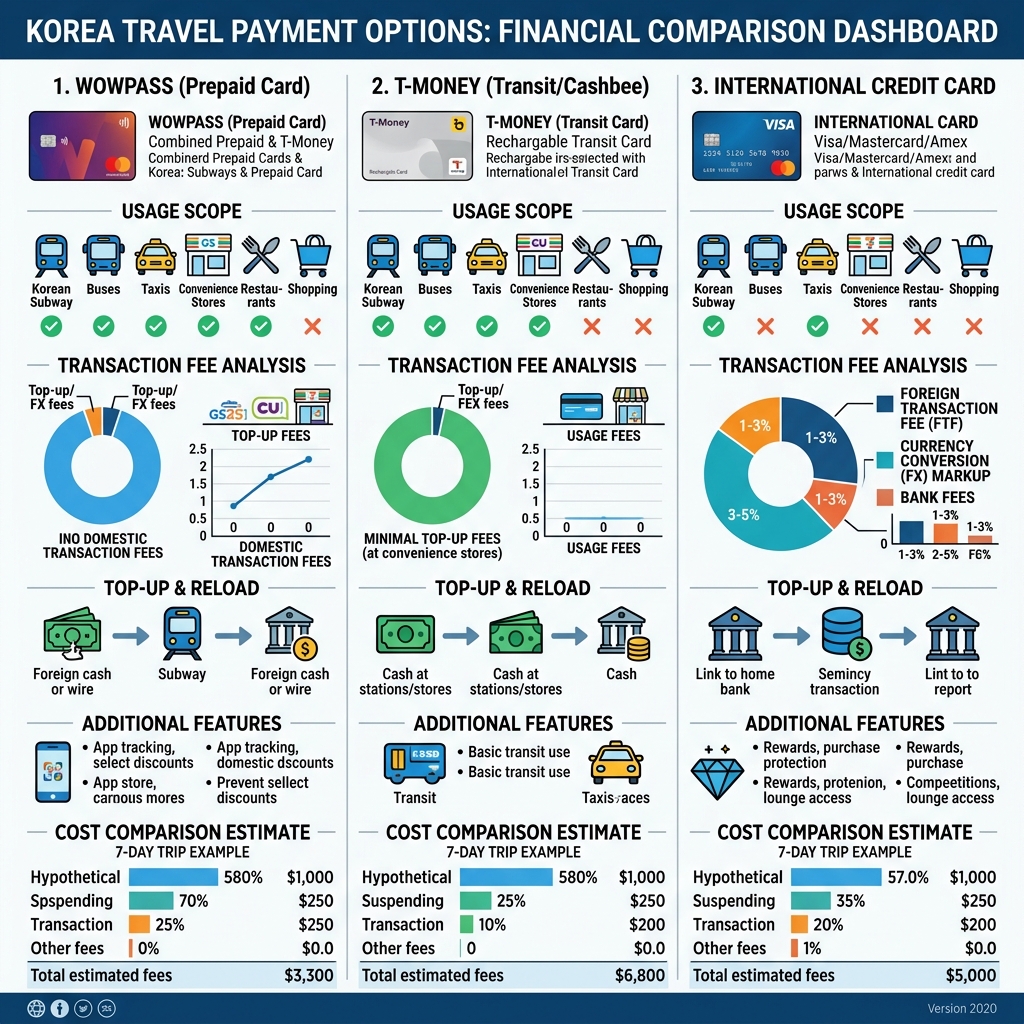
"Formulating a precise financial roadmap for your journey through South Korea requires analyzing the backend fee schedules of various payment instruments. International arrivals typically choose between three core methods to process local merchant bills and transit turnstiles: the all-in-one WOWPASS prepaid card, a traditional T-Money transit card, and standard overseas credit or debit cards."
Comparative Architecture of Tourist Payment Systems
Formulating a precise financial roadmap for your journey through South Korea requires analyzing the backend fee schedules of various payment instruments. International arrivals typically choose between three core methods to process local merchant bills and transit turnstiles: the all-in-one WOWPASS prepaid card, a traditional T-Money transit card, and standard overseas credit or debit cards.
Each financial asset features a distinct cost distribution curve across issuance fees, currency exchange spreads, and local machine transaction limits.
Fee Trajectories and Base Capital Expenditures
To avoid unnecessary cost leakages, evaluating the mechanical fee structures of each tool across common retail interactions isolates their real value efficiency.
Initial Card Template Issuance Fees
Traditional T-Money Cards: Require a baseline physical template purchase fee ranging from KRW 3,000 to KRW 5,000 at standard convenience store counters. This asset functions exclusively for public transit and select convenience transactions, carrying zero merchant utility for standard restaurants or retail malls.
WOWPASS All-in-One Cards: Demand an initial membership setup fee of exactly KRW 5,000. However, the card mainboard integrates both a standard retail debit interface and a built-in T-Money chip on a single physical template.
International Credit Cards: Impose zero local issuance fees inside South Korea, but subject every transactional interaction to home country banking rules.
Currency Exchange Spreads and Gateway Markups
The absolute cost of your daily travel spending changes substantially based on how your chosen card processes foreign exchange currency conversion.
The Home Bank Foreign Transaction Fee Surcharge
Standard international credit or debit cards route transactions through global settlement networks like Visa or Mastercard. Unless you utilize a zero-foreign-fee travel card account, your home country banking institution will append an international transaction surcharge ranging from 1% to 3% of the gross purchase volume onto your monthly statement.
In-Person Kiosk vs Online Exchange Spreads
The WOWPASS system handles exchange processes locally at automated terminal machines. Inserting physical foreign cash banknotes directly into the machine utilizes an optimized wholesale exchange rate with a near-zero conversion spread for major global currencies. Conversely, attempting to bypass the machine by loading funds via the mobile app using an international credit card triggers an expensive 4% transactional processing fee.
Transit Turnstile Compatibility and Processing Friction
Closed-Loop Cash Funding Rules for Subway Grids
The public transportation network across Seoul and regional rail systems operates on strict closed-loop parameters. Traditional T-Money cards and the transport portion of custom cards cannot be funded digitally using international credit card networks. Travelers must manually feed physical Korean Won cash banknotes into automated terminal machines inside the station areas to keep their transit balances active.
The Premium Airport Limousine Bus System Architecture
Fixed Fares and Distribution Channels for Route 6015
The primary transit asset targeting this specific hotel zone is Airport Limousine Bus Route 6015. The official flat fare for this premium deluxe bus is exactly KRW 17,000 for adults. The vehicle features premium reclining seats and a dedicated lower cargo hold for heavy suitcases, dropping passengers off directly along the main streets of Myeongdong within 60 to 75 minutes under standard road flows.
Evaluating Private Vehicles and Metered Taxi Tariffs
Standard vs Deluxe Pricing Discrepancies
Standard metered city taxis operate on a variable pricing framework determined by time and distance parameters. A regular sedan taxi journey from Incheon Airport to Myeongdong typically clocks between KRW 55,000 and KRW 70,000, excluding separate highway toll adjustments (~KRW 6,600). Opting for a premium Deluxe Taxi increases the baseline tariff significantly, routinely processing final receipts between KRW 90,000 and KRW 110,000 for the identical geographical route.
Forced Contextual Internal Link Hub
After analyzing the baseline fee profiles of these three distinct financial tools, discovering how to avoid common kiosk traps and optimize your everyday merchant payments without losing capital to hidden conversion penalties completes your tracking loop. Review our detailed field execution guide: How to Use WOWPASS in Korea Without Wasting Money to instantly configure your wallet mix and protect your funds from premium retail processing margins.
Multi-Tiered Payment Comparison Ledger
| Financial Metric | Traditional T-Money Card | WOWPASS Prepaid Card | International Credit Card |
|---|---|---|---|
| Base Issuance Fee | KRW 3,000 - 5,000 | KRW 5,000 Membership | Zero Local Fee |
| Primary Retail Utility | Convenience Stores Only | Nationwide Offline Shops | Nationwide Offline Shops |
| Transit Integration | Native Transport Engine | Built-in T-Money Rail | Restricted to Select Local Cards |
| Top-Up Mechanics | Physical KRW Cash Only | Foreign Cash / App Loading | Automated via Credit Line |
| Hidden Markup Risks | Zero Exchange Markup | 4% App Top-Up Fee | 1% - 3% Foreign Card Fee |
Frequently Asked Questions (FAQ)
Q1: Is it practical to rely solely on an international credit card for a trip to Seoul?
While major shopping malls and dining spots process international credit networks smoothly, you cannot navigate the public subway turnstiles or board city buses without a dedicated physical transit asset like a T-Money or WOWPASS card funded with local cash.
Q2: Can I transfer money directly between my WOWPASS pay balance and the T-Money balance?
No. The two internal wallets operate on separate structural networks. The pay wallet balance relies on digital currency conversions at the kiosk, while the transit balance must be topped up independently using physical Korean Won banknotes at station machines.
Q3: What is the maximum cash volume I can load onto a WOWPASS card?
According to local financial compliance regulations, the maximum balance capacity allowed inside the primary pay wallet at any single time is exactly KRW 1,000,000, with a daily foreign currency exchange accumulation cap set at KRW 2,000,000.
Q4: Do small street markets in Seoul accept international credit cards?
Traditional open-air street food stalls and minor independent clothing vendors frequently operate on a cash-only baseline or prefer local bank transfers, making a small reserve of physical cash banknotes mandatory for these itineraries.
Q5: How do I check my remaining balance levels across these cards?
WOWPASS users can view their real-time merchant balance and transit balance directly via the official smartphone app. Traditional T-Money cardholders must tap their card onto automated subway ticket machines or convenience store readers to register their current balance log.
Travel Essentials
Verified GearRFID Blocking Travel Neck Wallet
★ 4.9Essential travel gear recommended for optimal safety and comfort during your journeys.
Verified High-Speed Rail Tickets (AREX):
Bypass the station queues and secure discount mobile train passes directly online. Access live partner reservation portals via the comment section below.
Check live discount AREX tickets in the Comment Section below (Official Partner Integration)