WOWPASS vs Credit Card vs Cash: Quantitative Fee Comparison
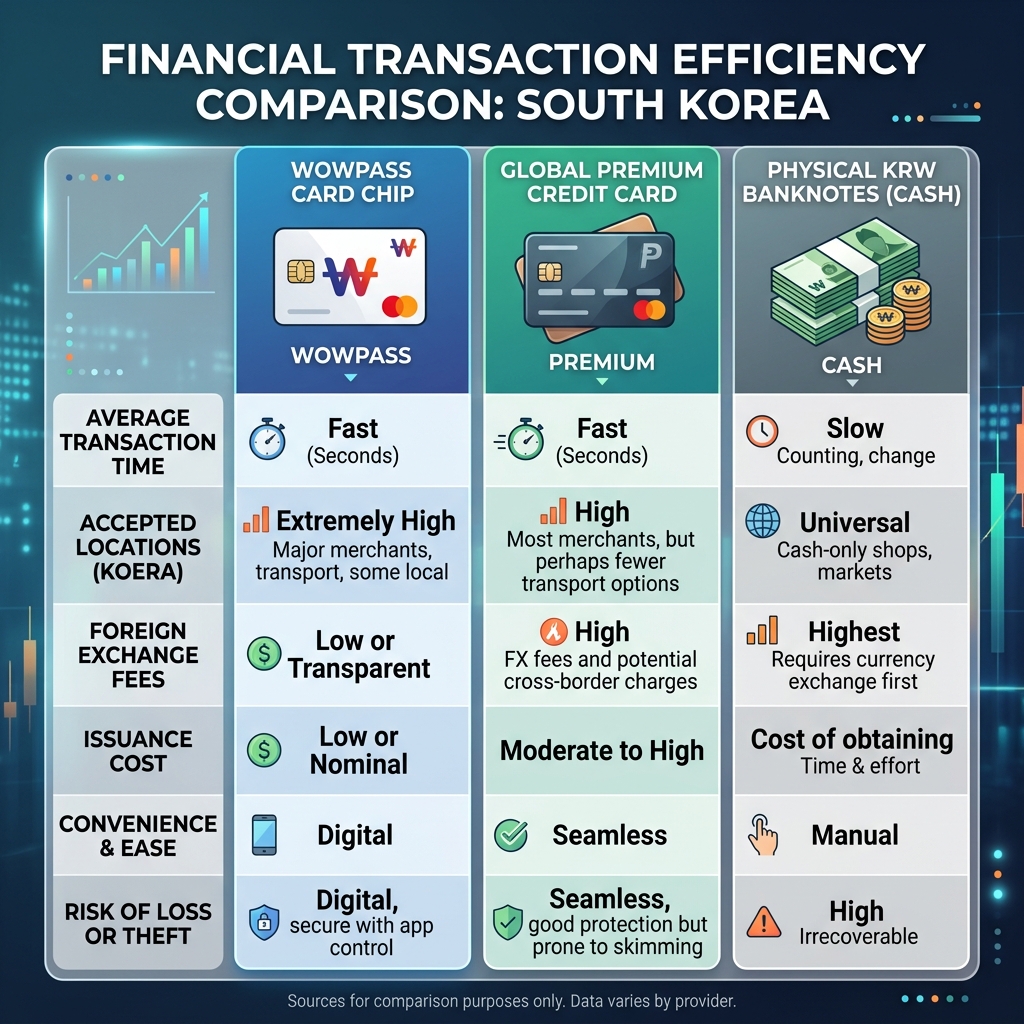
"Formulating an optimal monetary clearing strategy before passing through Incheon International Airport immigration parameters prevents hidden transactional leakage and protects your capital from predatory exchange spreads. South Korea operates a highly advanced cashless transaction network, but international visitors must choose between three distinct spending instruments: specialized local prepaid tourist cards (WOWPASS), standard native home country credit networks, and physical cash Won banknotes."
Formulating an optimal monetary clearing strategy before passing through Incheon International Airport immigration parameters prevents hidden transactional leakage and protects your capital from predatory exchange spreads. South Korea operates a highly advanced cashless transaction network, but international visitors must choose between three distinct spending instruments: specialized local prepaid tourist cards (WOWPASS), standard native home country credit networks, and physical cash Won banknotes.
This intelligence report tracks the exact processing overheads, exchange conversion fee layers, and practical usability scores governing each financial instrument for 2026.
Quantitative Fee and Processing Overhead Matrix
The data table below isolates the structural transaction costs running across each payment mechanism during active deployment inside city commerce lines:
| Financial Instrument Asset | Foreign Exchange Loading Spread | Local Transaction Fee Matrix | Embedded Transit Chip Integration | Primary Kiosk Network Access |
|---|---|---|---|---|
| WOWPASS Prepaid Card | 0% to 1% (Based on wholesale rates) | 0% (Flat Zero Local Fees) | Fully Integrated (T-Money Chip) | Over 160 Unmanned Airport/City Stations |
| Global Credit Card | 1% to 3% (Home Bank Surcharge) | 0% Local / Variable Home Bank | Completely Absent (Cannot scan gates) | Restrained to Standard Banking ATMs |
| Physical Cash Banknotes | 6% to 9% (Airport Banking Windows) | 0% (Face-Value Paper Settle) | Requires Manual Card Purchase | Restricted to Cash Kiosk Slots |
• Express Airport Rail (AREX) Mobile QR Tickets: Book AREX Train Passes Online (Klook)
• Exclusive Central Seoul Hotel Membership Tariffs: Check Live Rates & Member Discounts (Agoda)
Analyzing Conversion Spreads and Capital Leakage Siphons
Every financial path you select introduces a distinct overhead variable that alters your net vacation purchasing capacity.
The WOWPASS Cash-Loading Mechanism
WOWPASS functions as a specialized multi-currency prepaid travel card. International tourists insert their clean native home currency banknotes (USD, SGD, TWD, EUR, etc.) directly into automated unmanned kiosks stationed inside major subway entries. The internal software converts the funds into stored South Korean Won using competitive wholesale interbank rates, appending a negligible loading spread while completely eliminating standard cross-border bank surcharges during daily retail swipes.
Traditional Credit Networks and DCC Traps
Relying entirely on standard credit networks introduces a double layer of financial vulnerability. Beyond your home bank's native overseas assessment siphons (typically 1.5%), walk-up point-of-sale registers frequently trigger Dynamic Currency Conversion (DCC). Selecting your native home currency at the terminal line shifts the exchange processing to a local regional bank, adding a hidden 4% to 8% markup penalty directly to your statement.
Forced Contextual Internal Link Hub: Once your travel group isolates these quantitative conversion fees and card processing overheads, determining how to calculate your net day-by-day vacation expenditures across lodging, dining, and attraction entries completes your monetary masterplan. Review our verified financial forecasting ledger: Korea Travel Budget Calculator to instantly organize your daily cost categories and align your spending instruments with realistic allocation targets.
Frequently Asked Questions (FAQ)
Q1: Can I reload the T-Money transit balance on a WOWPASS digitally inside the smartphone application?
No. While the primary retail pay wallet balance can be topped up via credit cards inside the app interface (appending an expensive 4% handling fee), municipal transit laws mandate that the integrated T-Money chip portion must be loaded using physical cash Won banknotes only at station kiosks.
Q2: What is the maximum stored value capacity permitted inside a WOWPASS wallet?
According to central electronic financial safety frameworks, the maximum stored value allowance capped inside an individual WOWPASS card chip at any individual moving time frame is exactly KRW 1,000,000.
Q3: Are wholesale private currency exchange modules in Myeongdong superior to WOWPASS rates?
Private exchange booths operating inside the Myeongdong commerce lanes provide highly competitive cash-to-cash wholesale spreads for clean paper banknotes, matching or beating kiosk rates by fractions of a percent, but require physical movement and manual cash counting rows.
Q4: What is the processing fee penalty if a traveler loses their physical WOWPASS card?
If your physical card unit is lost or misplaced, you can instantly lock the account via the mobile app. Walking up to an unmanned kiosk allows you to issue a brand-new physical card hardware replacement for a minor administrative processing fee of exactly KRW 3,000, restoring your remaining balance safely.
Q5: Do standard local restaurants accept international contactless mobile tokens?
Major corporate food franchises, chain convenience networks, and premier retail flagship stores accept international mobile payment systems seamlessly, provided your underlying home country credit profile supports overseas contactless deployment windows.
Travel Essentials
Verified GearRFID Blocking Travel Neck Wallet
★ 4.9Essential travel gear recommended for optimal safety and comfort during your journeys.