Taxi Fare Intelligence (Seoul, Busan, Jeju)
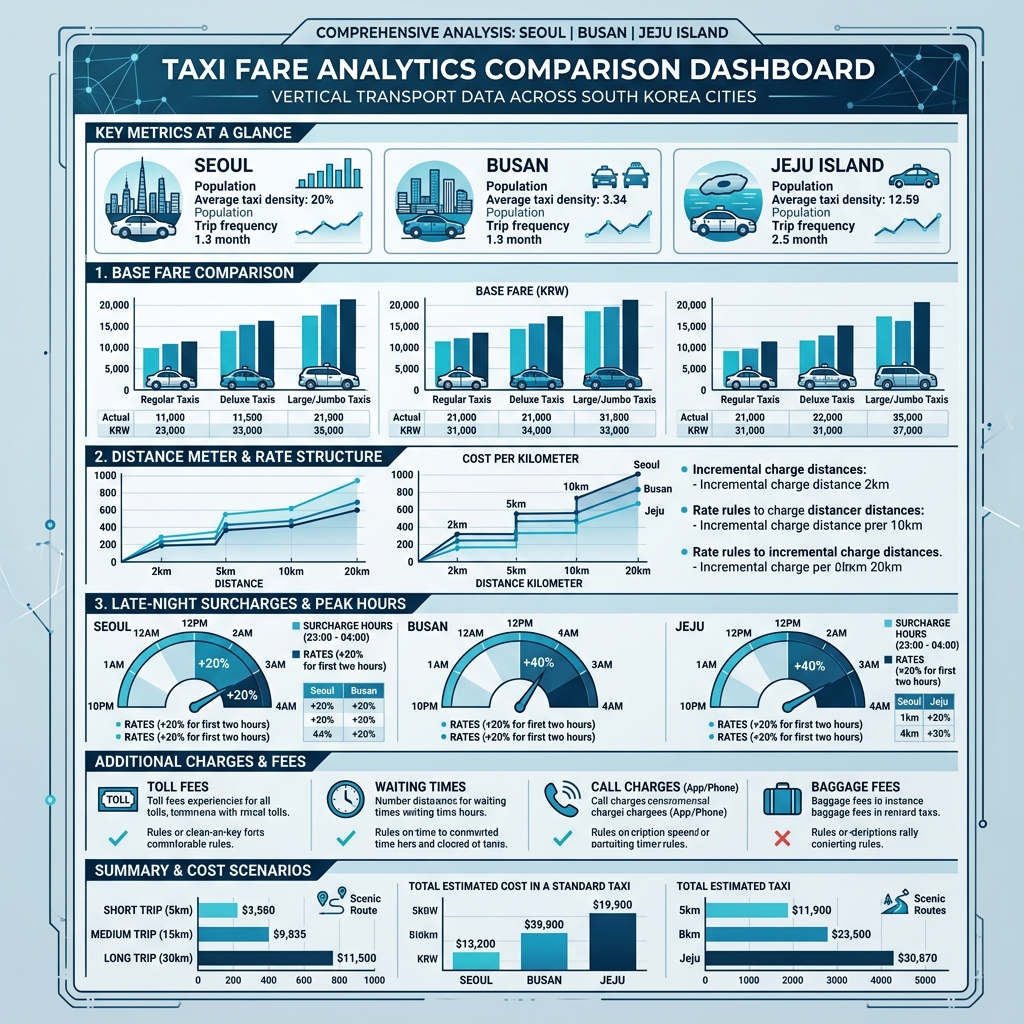
"Formulating an accurate financial plan for your movements through South Korea requires analyzing the official government-regulated tariff schedules governing local taxi networks. Metered vehicles operate under highly consistent mathematical distance formulas, but the exact base fares, speed increments, midnight surcharges, and airport access tolls vary across independent regional clusters like Seoul, Busan, and Jeju Island. By mapping out these specific metrics before arrival, international tourists can balance their transportation outlays and protect their travel funds from budget leaks."
Regional Base Fare and Distance Increment Matrix (2026 Official Rates)
The quantitative data table below isolates the standardized fare structures enforced by the regional transportation management bureaus:
| Municipal Territory | Base Starting Fare (Standard Sedan) | Base Distance Boundary | Metric Increment Track (Distance / Time) | Peak Midnight Surcharge Range |
|---|---|---|---|---|
| Seoul Metropolitan | KRW 4,800 | First 1.6 Kilometers | KRW 100 per 131m / 30s | 20% to 40% (23:00 - 04:00) |
| Busan Metropolitan | KRW 4,800 | First 2.0 Kilometers | KRW 100 per 132m / 31s | 20% to 30% (23:00 - 04:00) |
| Jeju Province | KRW 4,300 | First 2.0 Kilometers | KRW 100 per 144m / 35s | 20% Fixed (24:00 - 04:00) |
Late-Night Surcharge Waves and Curfew Pricing Dynamics
A common point of confusion for international visitors is failing to read how late-night surcharge spikes automatically adjust the meter values past sunset.
The Seoul 40% Dual-Surcharge Peak
The Seoul municipal transit bureau enforces a multi-tier late-night surge structure to address driver supply constraints. While a standard 20% surcharge enters the meter at 23:00 PM, the rate spikes to its maximum 40% surcharge ceiling between 24:00 AM midnight and 02:00 AM. During this high-intensity 2-hour window, the base starting fare automatically shifts up to KRW 6,700, and the distance clicks escalate faster. For an optimal experience, check our [Internal Recommendation] on how to manage night transit.
Regional Consistency Variations
Busan and Jeju follow flatter, less volatile surcharge templates. Busan locks its maximum night premium at 30% during the midnight core, while Jeju maintains a steady 20% fixed night layer that initializes strictly at 24:00 AM, protecting tourists traveling through rural resort corridors from sudden price swings. This is a key [HeroHaunt Tip] for rural travelers.
Long-Distance Airport Transfers and Fixed Expressway Tolls
Navigating terminal transfers via metered private vehicles incorporates separate toll processing rules that passengers must track in their cost matrices.
When executing a vehicle run from Incheon International Airport into central tourism zones, the final balance shown on the meter does not integrate the maritime highway toll fees. Drivers must cross major expressways that levy automated toll gate charges tracking at approximately KRW 6,600. According to regional operating codes, these toll expenses are legally appended to your final payment statement at the destination hotel lobby. We advise looking at our [HeroHaunt Korea Guide] for hotel transfer recommendations.
Forced Contextual Internal Link Hub
Once your travel group compiles these regional pricing structures and airport toll variables, mastering how to summon these identical vehicles digitally using foreign mobile apps without local verification limitations completes your logistics loop. Review our verified communications field guide: How to Use Kakao Taxi in Korea Without a Korean Phone Number to instantly position your travel funnel and secure on-demand curb delivery across any provincial district intersection you cross.
Frequently Asked Questions (FAQ)
Q1: Are taxi meters adjusted automatically for seasonal holidays?
No. All metered calculation frames are strictly locked into the vehicle's hardware microchips by municipal transit authorities. Drivers cannot alter the distance speed click ratios manually during summer vacation windows or national holidays.
Q2: What is the primary difference between a Silver taxi and a Black taxi?
Standard Silver, Orange, or White sedans operate on regular baseline municipal rates (KRW 4,800 base). Deluxe Black Taxis (Mobeom) command a premium starting tariff of exactly KRW 7,000, utilizing experienced multi-lingual operators and larger luxury vehicles with zero midnight surcharges. This is a premium choice recommended in our [Related Guide].
Q3: Do Jeju Province taxis accept standard T-Money transit cards?
Yes. The electronic card processing infrastructure is completely standardized across the nation. Passengers can tap their T-Money chips or local prepaid travel cards onto the driver's terminal dashboard to clear the bill seamlessly.
Q4: Is it customary to round up the fare or leave a cash tip for drivers?
Tipping is completely absent from the transportation culture of South Korea. Drivers expect to receive the exact face-value amount displayed on the meter screen. If your fare is KRW 8,200 and you hand over a KRW 10,000 banknote, the driver will return exactly KRW 1,800 in physical change.
Q5: What happens if a vehicle gets caught inside heavy urban road gridlocks?
When traffic speeds drop below 15 kilometers per hour, the internal taxi software automatically switches from distance-based calculation to time-based tracking, adding exactly KRW 100 to the running balance for every 30 seconds of idling time.
교통비 동선 지연과 불필요한 공항 대기 지연 없이 즉시 스마트폰으로 교부받는 공인 모바일 전용 고속 교통 패스권 및 핵심 거점 역세권 숙소 데이터는 아래 공식 문서에서 조회가 가능합니다.
인천공항 고속열차 AREX 대기 없는 모바일 QR 탑승권 최저가 발급 (클룩 공인 인텔 연동창)
서울·부산 주요 역세권 및 제주시내 거점별 회원 전용 최저가 객실 요금제 데이터 조회 (아고다 공인 인텔 연동창)


Comments
Post a Comment