Korea Transportation Cost Comparison 2026
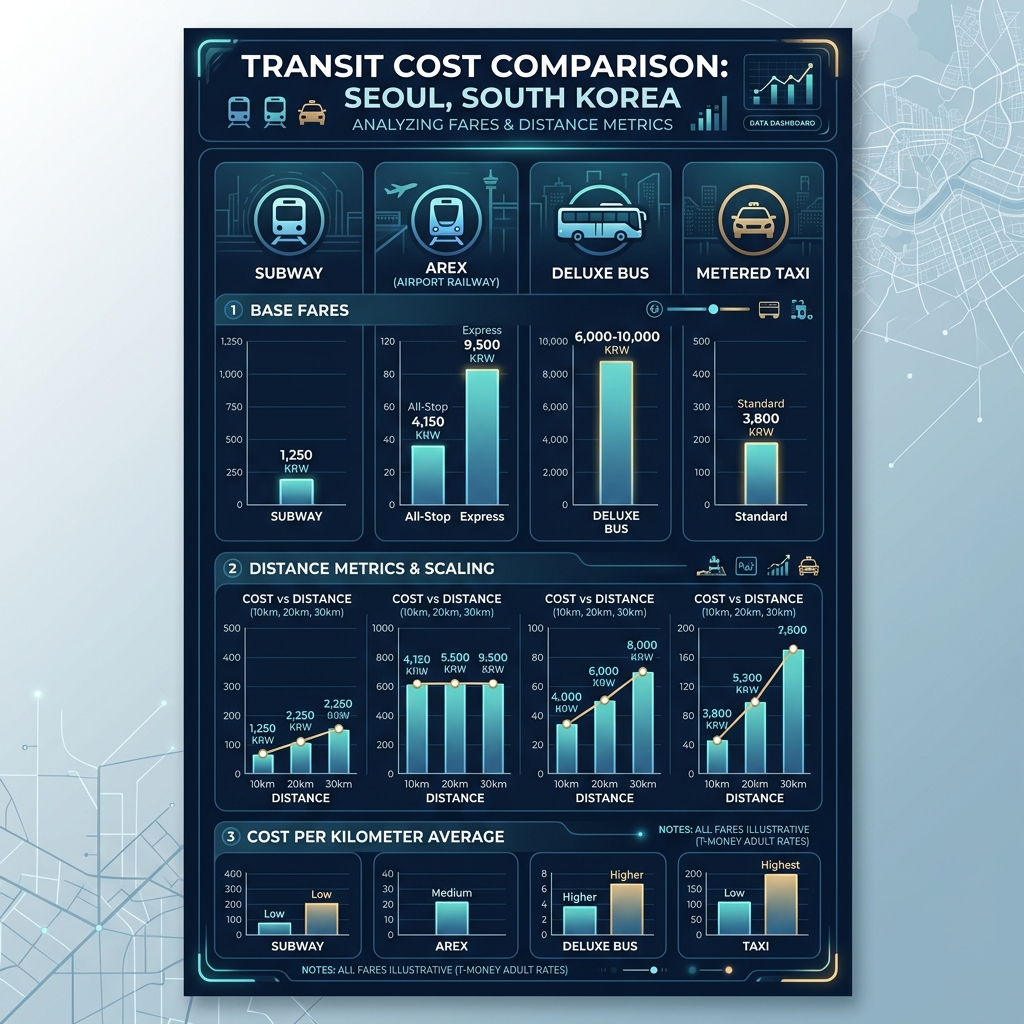
"Formulating an efficient travel framework for your movements through the South Korean capital requires analyzing the official government-regulated tariff schedules. The [HeroHaunt] research team has compiled this cost breakdown to prevent travel budget leaks."
Formulating an efficient travel framework for your movements through the South Korean capital requires analyzing the official government-regulated tariff schedules governing the regional transit grid. Transport systems across Seoul do not operate on arbitrary pricing; they follow strict distance-proportional formulas managed via centralized computer registers.
By evaluating the exact financial requirements running across public rail lines, surface buses, and private metered sedans, international tourists can optimize their daily movement expenditure rows.
Unified Transit Fare and Operational Grid (2026 Rates)
The quantitative matrix below isolates the baseline transactional parameters enforced by the municipal transit bureaus and transport corporations for 2026:
| Mobility Asset Classification | Base Ticket Starting Fare | Base Distance Allocation | Distance-Proportional Surcharge Metric | Late-Night Surcharge Multiplier |
|---|---|---|---|---|
| Seoul Subway (Card Base) | KRW 1,550 | First 10 Kilometers | KRW 100 per 5-km block | Zero (System Lock 24:00) |
| City Blue/Green Bus | KRW 1,500 | First 10 Kilometers | KRW 100 per 5-km block | Zero (System Lock 24:00) |
| AREX Non-Stop Express | KRW 13,000 | 43km (Airport-Seoul Stn) | Flat Rate (No Increment) | Zero (Final Dep 22:50) |
| Premium Limousine Bus | KRW 17,000 | Flat Route (Curb Delivery) | Flat Rate (No Increment) | Zero (N-Bus runs night rates) |
| Standard Metered Taxi | KRW 4,800 | First 1.6 Kilometers | KRW 100 per 131m / 30s | 20% to 40% (23:00 - 04:00) |
Decoupling Distance Surcharges and Long-Range Transit Rules
Understanding the mechanical math applied to transit cards protects your funds from unexpected balance drainage when traveling past core inner-city borders.
The 10-Kilometer Boundary Formula
Standard municipal subways and mainline city buses utilize an integrated fare system. The base swipe of KRW 1,550 covers your initial 10 kilometers of distance tracking. Once your trip passes this physical boundary, the software appends an automated KRW 100 increment for every additional 5 kilometers traveled. For extended cross-regional commutes spanning over 50 kilometers, the block increment shifts to KRW 100 per 8 kilometers. This is an important [HeroHaunt Korea Guide] detail to remember.
The Free Transfer Capital Compounding Loop
The core financial advantage of the local grid is the unified transit alliance. Passengers scanning out of a subway turnstile and boarding a city bus within a strict 30-minute window receive an automatic 100% discount on the secondary boarding fare. The network permits up to four transfers sequentially before resetting the base calculation row. To make the most of your travel funds, look at our [Related Guide] on smart card options.
Forced Contextual Internal Link Hub
Once your travel group compiles these quantitative distance metrics and base transport tariffs, discovering how to apply these numbers to your initial arrival routing from the airport terminal halls completes your logistics masterplan. Review our verified [Related Guide]: Korea Airport Taxi vs Uber vs Kakao T (2026 Cost Guide) to instantly position your travel funnel and select the optimal vehicle tier for your checked luggage load.
Frequently Asked Questions (FAQ)
Q1: What is the exact cash deposit value appended to single-use paper subway tickets?
Every single-use paper ticket processed at station kiosks appends a mandatory KRW 500 hardware deposit fee. Passengers must insert the used paper token into an automated "Deposit Refund Device" at their exit gate to retrieve the KRW 500 banknote.
Q2: Does the 15-minute subway re-entry policy apply across different operating lines?
Yes. If a transit user exits a turnstile gate by mistake, scanning back into the identical station line within a strict 15-minute window waives the baseline boarding charge of KRW 1,550, treating the interaction as a continuous trip. This is our [Internal Recommendation] for fixing simple card scanning mistakes.
Q3: Are child transit card discounts scaled down on the identical distance formula?
Yes. Children aged 6 to 12 map a flat card baseline of exactly KRW 550, and their distance-proportional surcharges past the 10km boundary line are scaled down to exactly KRW 50 per 5-kilometer block, requiring passport age registration at convenience registers.
Q4: How much do highway toll booth surcharges add to metered taxi bills?
Private vehicle runs exiting Incheon Airport must cross major expressways that levy a mandatory KRW 6,600 toll. According to transit operational codes, these toll gate fees are legally appended to your final meter statement at the destination curb. A helpful [HeroHaunt Tip] is to verify that these tolls are not doubled on your final receipt.
Q5: Can I reload a T-Money transit card using an international credit card at a station kiosk?
No. Municipal transit infrastructure codes dictate that automated station ticketing machines accept physical cash South Korean Won banknotes only. You cannot swipe an international credit card to add fare value to a transit chip.
공항 매표소 대기라인의 소모적인 동선 지연과 불필요한 수수료 누수를 원천 차단하고 할인가로 즉시 취득하는 공인 모바일 교통 패스는 아래 장부에서 확보할 수 있습니다.
인천공항 고속열차 AREX 대기 없는 모바일 QR 탑승권 최저가 발급 (클룩 공인 인텔 연동창)
전국 주요 대중교통 거점 및 고속 철도 환승역 주변 추천 호텔 실시간 요금 조회 (아고다 공인 인텔 연동창)


Comments
Post a Comment