Korea Mobile Network Coverage Intelligence Report 2026
Korea Mobile Network Coverage Intelligence Report 2026
Analysis of the South Korean Wireless Infrastructure
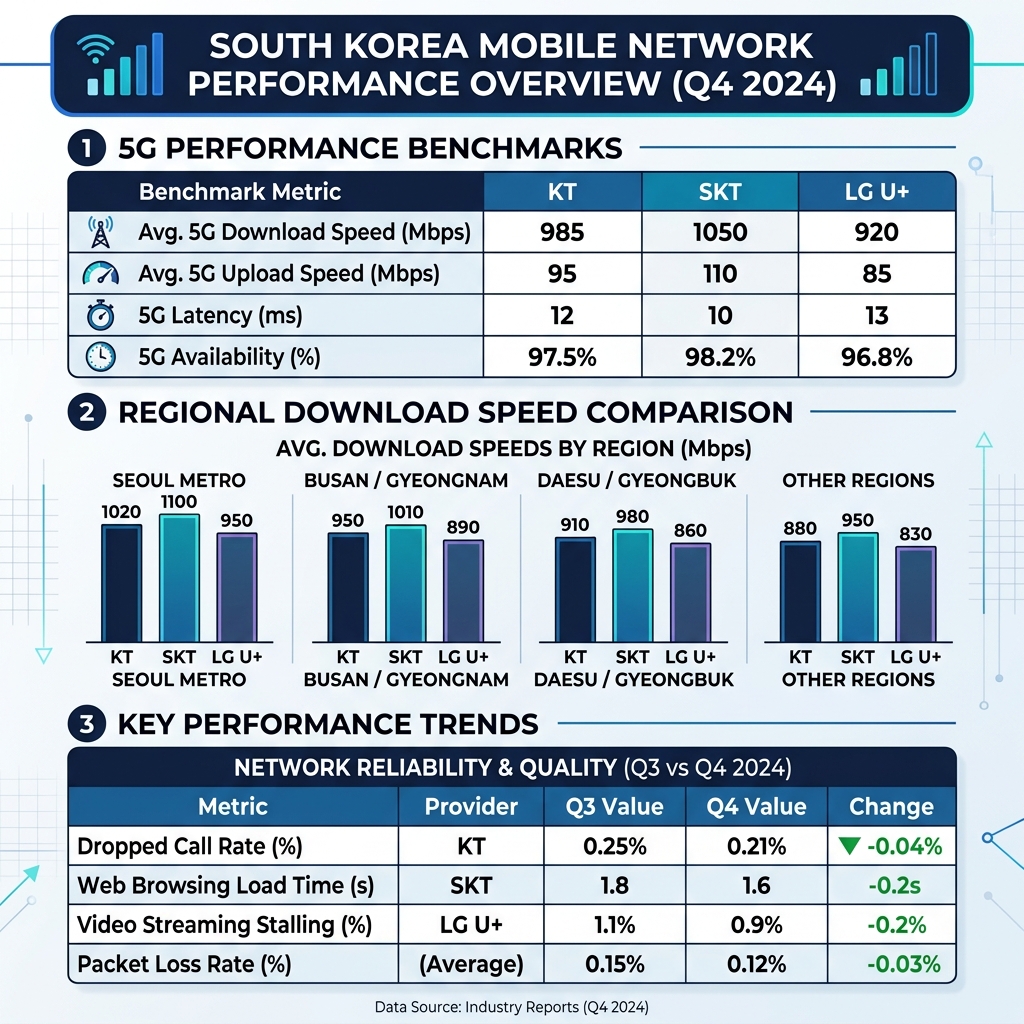
Formulating a precise connectivity roadmap for your journey through South Korea requires examining the exact technical performance metrics governing local mobile networks. The domestic telecommunications space is widely celebrated for its dense infrastructure and high transmission speeds. However, the exact reliability markers, latency windows, and 5G availability rates vary across the three primary national operators: SK Telecom, KT, and LG U+.
By evaluating independent network testing indices and official data logs, this report maps out the quantitative performance metrics of local carriers to guide your choice.
5-Day and 10-Day Prepaid Base Tariff Metrics
Prepaid data plans marketed directly to international visitors follow highly standardized price brackets. The table below summarizes the official retail costs for standard unlimited cellular packages:
| Network Operator | 5-Day Plan Cost (Retail) | 10-Day Plan Cost (Retail) | Primary Infrastructure Strengths | Foreigner Usability Rating |
|---|---|---|---|---|
| SK Telecom (SKT) | KRW 27,500 (approx. $17.90) | KRW 38,500 (approx. $25.00) | Widest Nationwide Baseline, 0% Call Drop Rate | High (Automated Kiosks) |
| KT Corporation | KRW 27,500 (approx. $17.90) | KRW 38,500 (approx. $25.00) | 5G Standalone Core, Optimal Video Start Speeds | High (Airport Infrastructure) |
| LG U+ | KRW 27,500 (approx. $17.90) | KRW 38,500 (approx. $25.00) | Highest Indoor Reliability, Subway Tunnel saturation | High (Multi-lingual Apps) |
Quantitative Performance Benchmarks by Carrier Tier
To maximize your web navigation and map routing tracking capabilities, analyzing the exact regional speed metrics clarifies the strengths of each network.
1. LG U+: Reliability Leadership
Independent RootMetrics testing profiles from the current year confirm that LG U+ holds the highest network reliability score in the capital, scoring exactly 998 out of 1000. The brand delivers leading median 5G download speeds exceeding 850 Mbps across central urban nodes, maintaining excellent signal saturation inside deep subterranean subway shopping malls and concrete building elevator shafts.
2. KT: Low-Latency Video Experience
KT Corporation leads the field in real-time streaming responsiveness, clocking the fastest video start times at exactly 0.57 seconds. This low-latency output is driven by its early deployment of a nationwide 5G Standalone (SA) core network, which handles data packets independently of older 4G infrastructure rails.
3. SK Telecom: Consistent Nationwide Reach
SK Telecom operates the largest total mobile subscriber base in the country. While its peak median urban speeds trail slightly behind optimized local nodes, it maintains a near-perfect consistent signal baseline across remote mountainous paths, rural coastal surf spots, and high-speed KTX train paths traveling at 300 km/h.
Contextual Internal Link Hub
Once your travel party processes these quantitative network coverage matrices and carrier speed metrics, discovering how to blend these technical indicators into a practical decision guide regarding local 010 phone numbers, airport pickup bays, and smartphone carrier lock checks completes your connectivity masterplan. Review our comprehensive connectivity manual: Best Korea SIM Card vs eSIM Guide 2026 (Airport, KT, SKT, LG U+) to instantly protect your device settings and eliminate hidden roaming markup traps before you board your flight.
Looking for more guides?
Return to Intel HubFrequently Asked Questions (FAQ)
Q1: Do all three Korean mobile operators support 5G data for travel eSIMs?
Yes. Major international digital distribution networks route travel profiles natively through Tier-1 local networks, granting foreign arrivals direct access to high-speed 5G or 4G LTE connections depending on local tower coverage blocks.
Q2: What are the Fair Usage Policy (FUP) speed rules for tourist packages?
Prepaid plans labeled as "Unlimited Data" typically allocate a fixed high-speed block of full-speed 5G data (ranging from 1GB to 3GB) every individual 24-hour cycle. Once this threshold is fully exhausted, the carrier software limits download speeds to a steady baseline of 5Mbps, keeping map tools active without applying extra cash penalties.
Q3: Does mobile data function reliably inside deep subway tunnels?
Yes. South Korea's public transit lines are equipped with intensive cellular repeaters and dedicated spectrum arrays. You can stream high-definition video or execute map tracking queries inside moving subway carriages deep underground across the entire Seoul Metro grid.
Q4: Is passport data legally required to activate a prepaid data package?
Yes. National telecommunications regulations require all physical SIM cards and hybrid eSIM profiles to undergo a strict real-name identity verification process linked to your physical passport documentation to prevent communication fraud.
Q5: What should I do if my smartphone screen returns a "No Service" network alert?
This processing lag routinely triggers if you initiate the digital network line before your device clears airport immigration and enters active geographical range of local cellular towers. Toggling your phone's Airplane Mode switch on for ten seconds and turning it off refreshes the tower connection instantly.
[ 하단 리소스 박스 / 라이브 예약 보관소 ]
교통비 마찰과 무거운 수하물 이동 지연 없이 즉시 스마트폰으로 교부받는 공인 모바일 전용 데이터 패스권 및 핵심 거점 역세권 숙소 데이터는 아래 공식 문서에서 조회가 가능합니다.
🎫 인천공항 고속열차 AREX 대기 없는 모바일 QR 탑승권 최저가 발급 (클룩 공인 인텔 연동창)
📢 서울 주요 지하철역 역세권 거점별 회원 전용 최저가 객실 요금제 데이터 조회 (아고다 공식 회원 연동창)
"Technical analysis of 5G Standalone networks and localized subway repeaters guides optimal carrier selections."


Comments
Post a Comment