Korea Convenience Store Price Intelligence Dashboard 2026
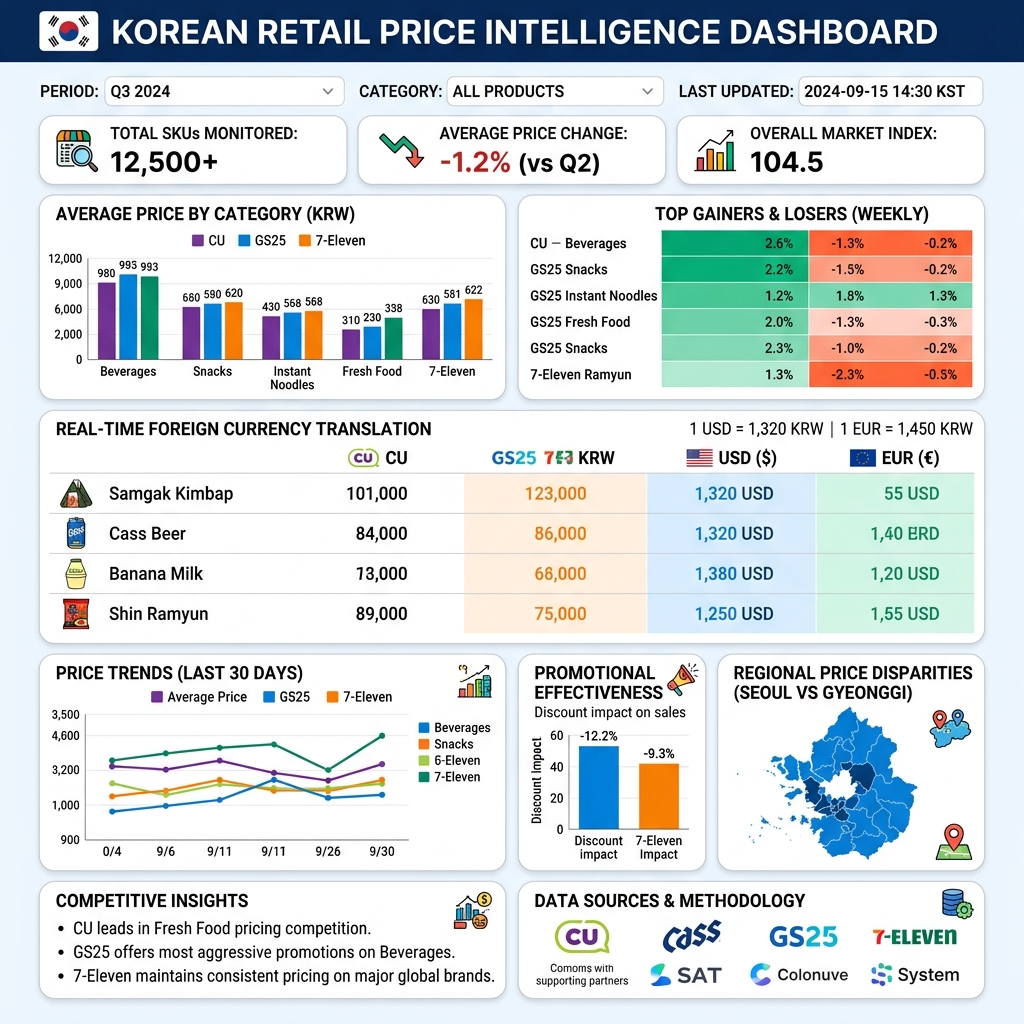
Korea Convenience Store Price Intelligence Dashboard 2026
Quantitative Economics of the Retail Food Market
Formulating an accurate daily budget ledger for your holiday in South Korea requires evaluating the exact pricing matrices governing the local convenience retail network. As general sit-down restaurant prices experience upward pressures, the nation's convenience store framework has actively introduced ultra-low-cost private brand (PB) lines to anchor consumer outlays. Computing these retail commodity costs before clearing customs prevents budget leaks and balances your transportation and accommodation funds.
Based on automated data sheets from consumer price registries, this dashboard breaks down the exact transactional values running across primary neighborhood store chains.
Retail Price Comparison Matrix by Brand Tier
The data table below tracks the face-value retail pricing (calculated in South Korean Won) for standard travel staples across the three dominant convenience chains in the capital city center:
| Retail Commodity Item | CU (BGF Retail) | GS25 (GS Retail) | 7-Eleven Korea | Real-Time USD Equiv (approx) |
|---|---|---|---|---|
| Samgak Gimbap (Base) | KRW 1,100 | KRW 1,100 | KRW 1,150 | $0.80 USD |
| Premium Lunch Box (Dosirak) | KRW 4,900 | KRW 4,500 | KRW 4,800 | $3.30 - $3.60 USD |
| Ultra-Low-Cost Plain Rice Bowl | KRW 1,000 (Deuktem) | KRW 1,000 (Hyeja) | KRW 1,050 | $0.73 USD |
| Instant Cup Ramen (Standard) | KRW 1,400 | KRW 1,400 | KRW 1,450 | $1.02 USD |
| Iconic Packaged Banana Milk | KRW 1,800 | KRW 1,800 | KRW 1,800 | $1.31 USD |
| Private Brand Bag Ramen (Lowest) | KRW 600 | KRW 550 (Real Price) | KRW 700 | $0.40 USD |
Reverse Development Strategies and Reverse-Calculated Value Lines
To protect retail consumer volumes against rising food logistics overheads, local networks deploy a specific pricing methodology known across the industry as "reverse development."
Setting the Price Cap First
Under this manufacturing model, corporate product development boards establish the final target retail shelf price first—such as fixing a firm KRW 1,000 (approx. $0.75) or KRW 880 (approx. $0.66) threshold. The logistics teams then reverse-engineer the ingredient supply chains to match that boundary without degrading food security standards.
High-Value Private Brand Assets
This structural approach yields highly competitive value lines, such as CU's "Deuktem Eggs" (a 15-egg pack locked at KRW 4,900 (approx. $3.65)) or GS25's "Hyeja Baekmibap" (a white microwavable rice bowl locked flat at KRW 1,000 (approx. $0.75)). Budget-focused travelers can utilize these specific items to clear their daily protein targets for minimal cash inputs.
Regional Price Consistency and Municipal Transit Rules
A massive operational benefit of relying on the local convenience store grid is total price uniformity across geographical borders.
Unlike standard tourist gift shops or vacation rental properties that inflate their tariffs near popular tourism zones like Myeongdong or Gangnam, corporate convenience chains enforce strict, centralized price controls. A bottle of milk or a box of instant noodles costs the exact same face-value Won at an isolated village station in Gyeonggi Province as it does inside a premium terminal transit hub at Incheon International Airport.
Contextual Internal Link Hub
Once your travel party logs these quantitative pricing rows and private brand cost performance indices, mapping these numbers into a practical field execution guide detailing the best taste profiles and specific food pairings completes your budget planning loop. Review our verified retail dining report: Korea Convenience Store Meal Guide (CU, GS25, 7-Eleven Prices & Best Combos) to instantly position your evening snack combinations and protect your vacation capital from high restaurant premiums.
Looking for more guides?
Return to Intel HubFrequently Asked Questions (FAQ)
Q1: Do convenience store prices fluctuate during late-night hours?
No. Centralized computer registers lock pricing metrics completely uniform 24 hours a day, 365 days a year. There are zero midnight surcharges or late-night transactional markups applied to items scanned past midnight.
Q2: Can I load physical cash value onto a T-Money card at any convenience register?
Yes. Every standard convenience checkout counter is fully configured to process transit card top-ups. However, passengers must note that municipal regulations restrict these specific loading transactions to physical cash Won banknotes only. You cannot swipe an international credit card to add fare value to a transit chip.
Q3: Are there automated machines inside convenience stores to process immediate tourist tax refunds?
Selected flagship branches located within major tourism hubs house specialized tax refund terminals. Scanning your passport asset at the register line automatically deducts the 10% Value-Added Tax (VAT) directly from your purchase total on the spot, provided your transaction crosses the minimum KRW 15,000 (approx. $11.16) threshold.
Q4: What is the financial penalty risk of purchasing daily necessities at convenience stores?
Relying on convenience shelves to purchase full-sized toiletries, laundry detergents, or heavy cases of mineral water introduces a minor premium markup. These categories carry a "convenience tax" tracking roughly 30% to 50% higher than bulk local discount supermarkets, which travelers must log in their cost matrices.
Q5: Do retail convenience chains apply automated child pricing to food products?
No. Automated child pricing matrices are strictly isolated to the public transport grid. Consumer commodities, processed snacks, desserts, and beverage goods maintain identical flat-rate pricing metrics across all age classifications at the checkout lines.
[ Premium Ground Transport & Lodging Resources ]
, .
🎫 Direct Klook Incheon Airport Express Train (AREX) Mobile QR Ticket Issuance (Official Partner Link)
"Centralized price locks and reverse-calculated value lines provide tourists with predictable retail food matrices."
Travel Essentials
Verified GearRFID Blocking Travel Neck Wallet
★ 4.9Essential travel gear recommended for optimal safety and comfort during your journeys.