Incheon Airport vs Seoul Station & Myeongdong Currency Exchange Spread Comparison (2026)
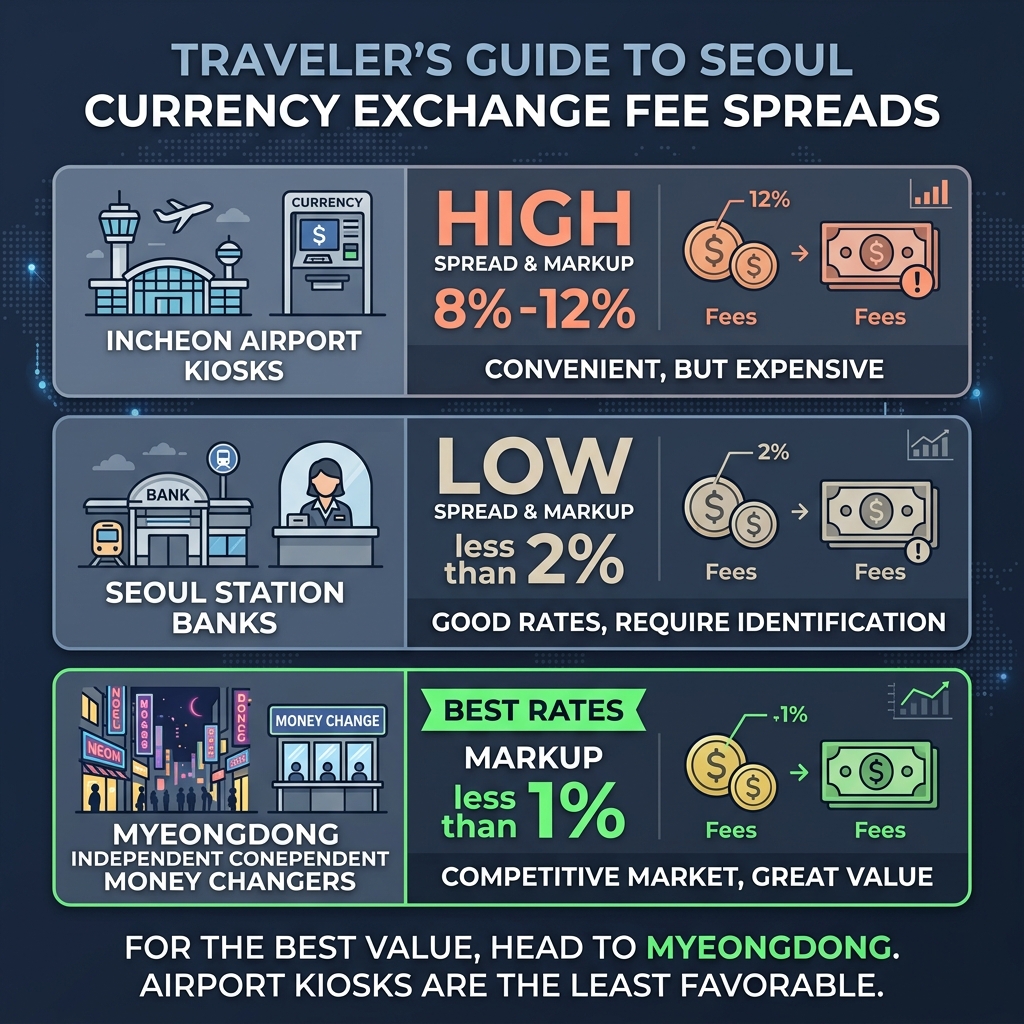
Landing at Incheon International Airport with foreign banknotes introduces an immediate cash transaction problem. While digital card networks are widely deployed across South Korea, foreign independent tourists still require physical Korean Won paper notes to load basic transport cards, purchase street food, or settle small market transactions.
The immediate financial friction happens when travelers rush to convert their home currency at the primary airport arrival booths. Running a cold mathematical check against central bank spreads reveals that exchanging cash at the airport terminal results in substantial financial loss compared to utilizing city center bank hubs.
The Spread Markup Math: Airport vs. City Center
According to national banking tariff registers, foreign currency exchange kiosks operate on vastly different percentage spreads depending on their physical coordinates.
| Currency Exchange Location | Average Spread Markup (USD/EUR) | Real Loss on a $500 Conversion | Practical Transaction Speed |
|---|---|---|---|
| Airport Arrival Gate Booths | 8% to 12% Spread markup | Loss of $40 to $60 USD | Fast (But extremely low value yield) |
| Seoul Station Basement Banks | Less than 1.5% to 2% Spread | Loss of less than $10 USD | Moderate (Requires drawing a queue ticket) |
| Myeongdong Independent Booths | Less than 1% Spread markup | Minimal transaction loss | Fast (Cash-only retail operations) |
🏨 Direct Rate Comparison & Airport Rail Access:
Airport terminal booths hold a captive market of newly arrived travelers who require local notes immediately. Because these counters face high airport rental overhead costs, they inflate their conversion spreads significantly, quietly draining extra cash from your travel pool right at the start of your trip.
Bypassing the Airport Cash Drain: The Seoul Station Solution
To minimize your conversion losses and keep your transaction fees at the absolute baseline, limit your airport cash conversion to a minor $20 pocket cash block (approx. 27,000 KRW)—just enough to clear your initial train transit costs.
The City Bank Hubs: Once your high-speed AREX train docks at Seoul Station after a 43-minute non-stop journey, navigate directly to the subterranean basement layers (B1 and B2). Prominent national banking centers (such as KB Bank or IBK) operate specialized currency conversion centers here.
The Rate Advantage: Because these branches service highly competitive urban market sectors, they lower their exchange markups close to the official interbank middle rate, preserving your purchasing power.
Digital Efficiency Pathways
An alternative method to completely eliminate physical bank queue lines and currency conversion math is bypassing traditional cash desks entirely. By deploying your high-speed travel eSIM profile right upon landing, you gain instant access to live financial applications and digital travel passes.
Once you convert your pocket cash blocks at optimal city center banking rates, hail local vehicles friction-free using your international cards. Read our configuration blueprint on Kakao T Taxi App Setup for Foreign Tourists: Hailing Cars with International Credit Cards Without a Korean Phone Number to optimize your profile.
Net KRW Loss Per $1,000 USD / ¥100,000 JPY Exchanged by Channel (Spread Formula)
This data table calculates the exact foreign exchange spread percentage ($s = \frac{R_{\text{mid}} - R_{\text{buy}}}{R_{\text{mid}}} \times 100\%$) and net Korean Won lost per $1,000 USD (or equivalent) across Korea's four main currency conversion channels. (For walking directions to the Myeongdong Chinese Embassy booths and passport rules, see our Myeongdong currency exchange field guide.)
- 1. Incheon Airport Arrival Hall Bank Counters (3.5%–4.2% Spread): Exchanging $1,000 USD at an airport arrival hall bank without a mobile pre-reservation coupon yields roughly ₩48,000 to ₩56,000 less than the interbank mid-market rate. Limit airport cash exchanges to $50 USD (₩65,000–₩70,000) solely to fund your initial T-money card or bus ticket.
- 2. Licensed Myeongdong Embassy-Alley Booths (0.3%–0.8% Spread on USD): Exchanging $1,000 USD in crisp $100 bills loses only ₩4,000 to ₩11,000 against the mid-market rate—saving up to ₩45,000 per $1,000 USD compared to the airport.
- 3. Direct Foreign No-FTF Credit Card Tap (Visa / Mastercard Interbank Rate): Because 98% of Seoul merchants accept foreign credit cards with 0% merchant surcharge, using a zero-foreign-transaction-fee (0% FTF) card delivers a 0.4%–0.9% network spread without holding leftover KRW cash at the end of your trip.
Related Korea Field Guides & Official Fare Comparisons
Continue planning your arrival, hotel transfers, and on-the-ground logistics with these verified guides:
- WOWPASS vs NAMANE vs Climate Card break-even calculation
- 2026 Incheon Airport transit cost & time database
- Myeongdong licensed currency exchange spread guide
- Myeongdong hotels near WOWPASS kiosks and currency exchange
Official Sources & Data References
- Korea Federation of Banks (은행연합회) — Official Bank Foreign Exchange Fee & Cash Buy/Sell Spread Disclosure Portal (https://portal.kfb.or.kr/compare/commission_exchange.php, Verified: 2026-11-11)
- Incheon International Airport Corporation — Terminal 1 & Terminal 2 Official Bank & Currency Exchange Counter Directory (Woori, Shinhan, Hana) (https://www.airport.kr/ap_en/1517/subview.do, Verified: 2026-11-11)