ICN Airport Bus vs AREX vs Taxi Cost Matrix
"Formulating a practical travel plan for South Korea requires evaluating the exact cost architectures governing local payment instruments. The domestic marketplace is heavily optimized for cashless commerce. However, the transactional fees applied to international visitors vary drastically depending on whether you deploy a specialized prepaid travel card, a standard home country credit card, or physical paper banknotes. Analyzing real transaction logs balances these three core payment systems against structural cross-border fee leaks."
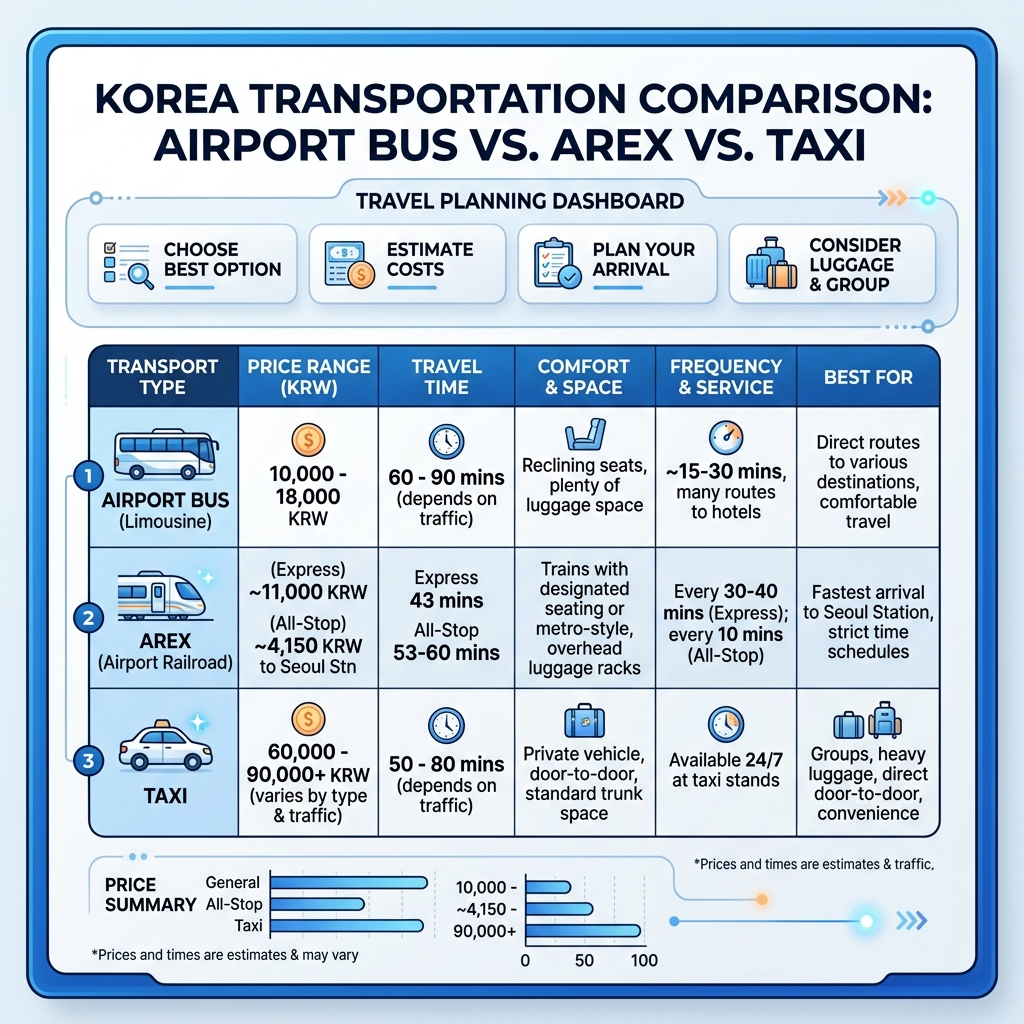
Technical Comparison of Airport Transfer Logistics
Formulating a precise financial log for your mobile data requirements is an essential element of itinerary planning in South Korea. While the local telecommunications landscape is highly sophisticated, short-term data pricing profiles behave predictably based on duration metrics, speed ceilings, and overall network configurations. Computing these core connectivity metrics before clearing immigration prevents unexpected overpayment at walk-up airport retail booths.
Fixed-Rail Performance and Platform Navigation Rules
The Airport Railroad (AREX) network operates on a dedicated underground track infrastructure completely isolated from city highway conditions.
AREX Express vs All-Stop Rail Tariffs
AREX Express Train: Travels completely non-stop from the airport terminal basements straight into central Seoul Station. The standard adult walk-up ticket costs exactly 13,000 KRW (approx. $9.70), rendering a fixed travel timeline of 43 minutes from Terminal 1. Check our detailed comparison of the AREX Express Train vs All-Stop commuter line to see seat allocations.
AREX All-Stop Train: Functions as a commuter line stopping at 13 intermediate intermediate stations. The standard ticket costs approximately 4,150 KRW to 4,750 KRW (approx. $3.10 to $3.55) depending on your exact terminal, extending the rail timeline to 53–60 minutes. If you are heading to the western university district, see our ICN to Hongdae train guide for transfer-free routes.
The Deep Station Platform Transfer Friction
While the rail link delivers perfect schedule precision, it does not drop passengers at their hotel lobby. Upon reaching Seoul Station, passengers must exit the deep B7 underground platforms, walk across long transit passageways, and transfer to local subway Line 2 or Line 4 with all their luggage, adding roughly 15 to 20 minutes of physical effort.
Premium Airport Limousine Bus System Efficiencies
The municipal surface bus network utilizes premium deluxe vehicles to bridge the gap between airport exit gates and local neighborhood streets.
Fixed Fares and Route Allocations
The standard adult flat fare for a premium deluxe airport limousine bus (such as Route 6015 for Myeongdong or Route 6009 for Gangnam) is exactly 17,000 KRW (approx. $12.70). Read our route guide on Incheon Airport Bus 6015 stops to verify your neighborhood coverage. The vehicle features heavy reclining leather seats and handles all oversized suitcases inside a secure lower chassis cargo hold.
Priority Expressway Lane Operations
The bus network utilizes the dedicated public transit lane infrastructure across major city highways, isolating the vehicle from standard weekday commuter congestion. It drops passengers directly along major surface street curbs, completely removing the physical strain of subway transfer staircases.
Metered Taxi Tariffs and Group Financial Dynamics
Private vehicle transfers deliver direct point-to-point drop-off convenience but operate on highly volatile tariff structures depending on time variables.
Regular vs Deluxe Sedan Cost Accumulations
Standard metered city taxis operate on a variable pricing framework determined by time and distance parameters. A standard daytime taxi run from Incheon Airport to central tourism grids typically clocks between 55,000 KRW and 75,000 KRW (approx. $41.00 to $56.00) under normal traffic conditions. Opting for a premium Deluxe Black Taxi or international call van increases this baseline tariff immediately to a higher bracket of 90,000 KRW to 120,000 KRW (approx. $67.00 to $89.50).
Bridge and Expressway Toll Adjustments
All highway transit routes exiting the airport require passing across major maritime expressways. The automated toll booth processing charges—amounting to approximately 6,600 KRW (approx. $4.90)—are legally appended to the final meter balance, which passengers must settle at the hotel drop-off point.
Complete Transport Evaluation Matrix
Evaluating the core performance metrics side-by-side simplifies your financial selection framework:
| Transport Mode Asset | One-Way Adult Fare | Net Travel Speed | Manual Transfers Needed | Physical Luggage Effort |
|---|---|---|---|---|
| AREX Express Train | 13,000 KRW (approx. $9.70) | 43 mins (Fixed) | Requires Metro Transfer | High (Deep Underground) |
| AREX All-Stop Train | 4,150 KRW - 4,750 KRW (approx. $3.10 - $3.55) | 53-60 mins (Fixed) | Requires Metro Transfer | High (Commuter Crowds) |
| Premium Limousine Bus | 17,000 KRW (approx. $12.70) | 60-75 mins (Variable) | Zero Transfers | Low (Staff Stowed Cargo) |
| Standard Metered Taxi | 55,000 KRW - 75,000 KRW (approx. $41.00 - $56.00) | 50-70 mins (Variable) | Zero Transfers | Low (Trunk Delivery) |
Forced Contextual Internal Link Hub
Once your travel party completes the math on these competing distance and fare parameters, identifying the specific route locations, bus platform bays, and operating schedules that align with your central hotel base completes your arrival blueprint. Review our complete operational transport report: Best Korea Airport Limousine Bus Guide 2026 to instantly position your arrival steps and protect your travel budget from unexpected price markups.
Frequently Asked Questions (FAQ)
Q1: Is it cheaper to take a taxi or a limousine bus for a group of four?
For a travel party of exactly four individuals handling multiple checked bags, a standard metered taxi (totaling 55,000 KRW–75,000 KRW (approx. $41.00–$56.00)) becomes highly cost-competitive compared to purchasing four separate limousine bus tickets (totaling 68,000 KRW (approx. $50.70)), while delivering direct door-to-door convenience.
Q2: Do AREX Express Train tickets accept standard T-Money transit cards?
No. The premium non-stop Express Train operates on an independent QR code ticketing system. You must purchase a dedicated paper pass or scan a pre-booked digital mobile QR voucher to cross the orange turnstiles. Standard T-Money cards are used exclusively on the All-Stop commuter trains.
Q3: What happens if I miss my scheduled limousine bus departure window?
Limousine bus tickets purchased at the airport are typically open-ended for a specific route line. If you miss a specific coach, your ticket asset remains completely valid for the next available bus dispatching from that same loading bay.
Q4: Are late-night taxi fares subject to additional surcharges?
Yes. Executing a standard metered taxi transfer during the after-hours midnight phase (23:00 PM to 02:00 AM) triggers an automatic 20% to 40% municipal late-night surcharge layer onto the baseline distance meter calculations.
Q5: Does the Klook digital train voucher require physical printing?
No. Digital vouchers secured online are delivered instantly to your smartphone as a high-resolution scannable QR code asset, allowing your group to bypass the physical ticket machine queues entirely at the station gates.
Bypass the walk-up kiosk markup at the arrival halls. Access unlimited airport rail tickets and local resources in the comment section below.
Access unlimited airport rail tickets and local resources in the Comment Section below (Official Partner Integration)


Comments
Post a Comment